Book contents
- Frontmatter
- Contents
- Figures and Tables
- Acknowledgements
- Note on Conventions
- Notes on Contributors
- Introduction
- 1 Kunnā nakrahu al-kitāb: Scripture, Transmission of Knowledge, and Politics in the Second Century AH (719–816 ce)
- 2 The History of the Adhān: a View from the Hadith Literature
- 3 Ibn al-Mubārak, Traditionist
- 4 Early ‘Traditionist Sufis’: A Network Analysis
- 5 The Common Link and its Relation to Hadith Terminology
- 6 Hadith Criticism between Traditionists and Jurisprudents
- 7 Hadith Criticism in the Levant in the Twentieth Century: From ẓāhir al-isnād to ʿilal al-ḥadīth
- 8 The Reception and Representation of Western Hadith Studies in Turkish Academe
- 9 Can Different Questions Yield the Same Answers? Islamic and Western Scholarship on Shiʿi Narrators in the Sunni Tradition
- Index
4 - Early ‘Traditionist Sufis’: A Network Analysis
Published online by Cambridge University Press: 01 October 2020

Book contents
- Frontmatter
- Contents
- Figures and Tables
- Acknowledgements
- Note on Conventions
- Notes on Contributors
- Introduction
- 1 Kunnā nakrahu al-kitāb: Scripture, Transmission of Knowledge, and Politics in the Second Century AH (719–816 ce)
- 2 The History of the Adhān: a View from the Hadith Literature
- 3 Ibn al-Mubārak, Traditionist
- 4 Early ‘Traditionist Sufis’: A Network Analysis
- 5 The Common Link and its Relation to Hadith Terminology
- 6 Hadith Criticism between Traditionists and Jurisprudents
- 7 Hadith Criticism in the Levant in the Twentieth Century: From ẓāhir al-isnād to ʿilal al-ḥadīth
- 8 The Reception and Representation of Western Hadith Studies in Turkish Academe
- 9 Can Different Questions Yield the Same Answers? Islamic and Western Scholarship on Shiʿi Narrators in the Sunni Tradition
- Index
Summary
Introduction
Roy P. Mottahedeh's Loyalty and Leadership in an Early Islamic Society articulates a widely cited model of societal cohesion during the late-ʿAbbasid and Buyid periods, a time typified by rapid institutional segmentation and widespread sectarian antipathies. In the broadest theoretical sense, Loyalty and Leadership examines how the conditions that engender group-level specialisation and differentiation motivate cooperation or competition. In a series of astute case studies, Mottahedeh highlights a pervasive ethos of ‘negative loyalties’ as a barrier to the success of various actors in building and maintaining collaborative ventures. This chapter joins the debate over the dynamics of co-evolutionary social processes during the third and fourth/ninth and tenth centuries by examining the case of cooperation between hadith specialists and Sufis.
By the end of the sixth/twelfth century, mass participation in hadith transmission and Sufi ritual had become dominant features of the intellectual and practical landscape of Sunnism. The later situation appears to contrast sharply with an earlier period when hadith specialists and Sufis are thought to have found little common ground. This model of the diachronic development of relations between hadith specialists and Sufis, which I term the ‘split–reconciliation hypothesis’, has appeared in various forms; few have articulated its elements with the erudition of Christopher Melchert. In one study of the differentiation of these groups, Melchert echoes the negativeloyalties thesis in his contention that hadith specialists and Sufis achieved only a modicum of comity near the end of the fourth/tenth century, after ‘ha[ving] been separated for more than a century’. Even then, he is able to marshal only tacit evidence of shared orientations. Thus, whereas intensive time commitments were the norm for becoming a leading hadith expert or Sufi in the third/ninth century – memorising hundreds of thousands of reports or performing ‘heroic’ acts of worship, respectively – by the fourth/ tenth century, ‘it presumably became easier again to pursue both hadith and renunciation’. In Melchert's view, this rapprochement occurred thanks to both the rise of ‘authoritative’ hadith works, such as the Ṣaḥīḥayn of Abū ʿAbd Allāh al-Bukhārī (d. 256/870) and Muslim ibn al-Ḥajjāj (d. 261/875), and the widespread acceptance amongst the Sufis of a type of piety that prioritised an ‘inward moral attitude’.
Information
- Type
- Chapter
- Information
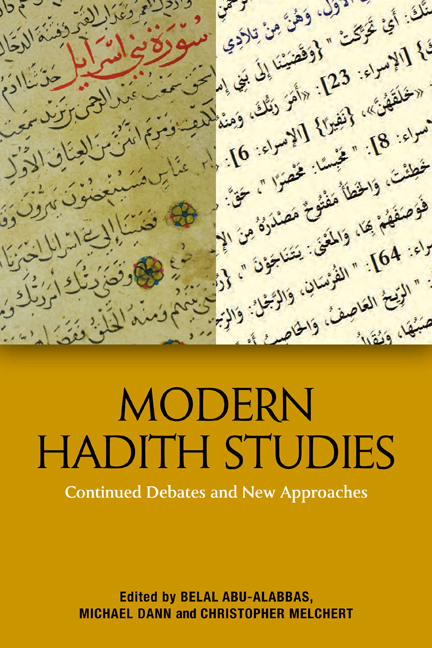
- Modern Hadith StudiesContinuing Debates and New Approaches, pp. 70 - 96Publisher: Edinburgh University PressPrint publication year: 2020
Accessibility standard: Unknown
Why this information is here
This section outlines the accessibility features of this content - including support for screen readers, full keyboard navigation and high-contrast display options. This may not be relevant for you.Accessibility Information
Accessibility compliance for the PDF of this chapter is currently unknown
and may be updated in the future.