Book contents
- Frontmatter
- Contents
- List of Tables and Figures
- Notes on Contributors
- 1 Introduction: Everyday Life in (Post-)Neoliberal Latin America
- 2 Imaginaries, Sociability and Cultural Patterns in the Post-Neoliberal Era: A Glance at the Argentinean, Paraguayan, and Venezuelan Experiences
- 3 Making Neoliberal Selves: Popular Psychology in Contemporary Mexico
- 4 From Uribe’s “Democratic Security” to Santo’s Peace Accords with the FARC: Hate, Fear, Hope and other Emotions in Contemporary Colombian Politics
- 5 Cine Bajo Tierra: Ecuador’s Booming Underground Cinema in the Aftermath of the Neoliberal Era
- 6 Neoliberalising Humanity: Culture and Popular Participation in the Case of the Street Market of Caruaru, Brazil
- 7 The Contribution of the Catholic Magazine Espacio Laical and the Constitution to the Cuban Public Sphere
- 8 Argentina: The Philosophical Resistance to the Conquest of the Soul1
- 9 Fleeing (Post-)Chávez Memories: The 1990s and the Black Friday Generation
- 10 Re-imagined Community: The Mapuche Nation in Neoliberal Chile
- 11 Neoliberalism and the Negotiation of the American Dream in Contemporary Latina Narratives
- 12 Bare Life in Contemporary Mexico: Everyday Violence and Folk Saints
- Index
9 - Fleeing (Post-)Chávez Memories: The 1990s and the Black Friday Generation
Published online by Cambridge University Press: 20 April 2022

Book contents
- Frontmatter
- Contents
- List of Tables and Figures
- Notes on Contributors
- 1 Introduction: Everyday Life in (Post-)Neoliberal Latin America
- 2 Imaginaries, Sociability and Cultural Patterns in the Post-Neoliberal Era: A Glance at the Argentinean, Paraguayan, and Venezuelan Experiences
- 3 Making Neoliberal Selves: Popular Psychology in Contemporary Mexico
- 4 From Uribe’s “Democratic Security” to Santo’s Peace Accords with the FARC: Hate, Fear, Hope and other Emotions in Contemporary Colombian Politics
- 5 Cine Bajo Tierra: Ecuador’s Booming Underground Cinema in the Aftermath of the Neoliberal Era
- 6 Neoliberalising Humanity: Culture and Popular Participation in the Case of the Street Market of Caruaru, Brazil
- 7 The Contribution of the Catholic Magazine Espacio Laical and the Constitution to the Cuban Public Sphere
- 8 Argentina: The Philosophical Resistance to the Conquest of the Soul1
- 9 Fleeing (Post-)Chávez Memories: The 1990s and the Black Friday Generation
- 10 Re-imagined Community: The Mapuche Nation in Neoliberal Chile
- 11 Neoliberalism and the Negotiation of the American Dream in Contemporary Latina Narratives
- 12 Bare Life in Contemporary Mexico: Everyday Violence and Folk Saints
- Index
Summary
There is no original past to redeem; there is the void, the orphanhood, the unbaptized earth of the beginning, the time that from within the earth looks upon us.
Ana Mendieta
Introduction
Over recent years, we have witnessed the end of the so-called Latin-American pink tide. After the neoliberal decade, leftist governments that occupied power in Argentina, Brazil, Bolivia, Chile, Ecuador, Nicaragua, Uruguay, and Venezuela might not have fulfilled the political and social expectations they generated at the beginning of the 21st century. Some recent articles even refer to the failure or setback of the left. The uncertainty generated by this end of an era compels us to inquire about the paradigms that sustained some of these post-neoliberal projects. In particular, Laclau's theory on populism offered a conceptual foundation for the legitimization of these governments, positing that politics serve to discursively constitute an antagonism between two subjects: on the one hand, the people, and on the other, the one anathematized as anti-popular, elitist, oligarchical, imperialist (Laclau, 2005, p.99). Venezuela, as any other country in the region, reveals the devastating consequences of the construction of political binary imaginaries, not only those of the state power but also those from its opposition. As we face the collapse of the Chavist hegemony, by now bereft of a concrete alternative horizon, it is helpful to review the subjectivities and affects that did not enter the polarized political discourses of the last decade. Memories of the 1990s offer a particularly productive field, as it was in that period when disputes for the interpretive legitimacy of the current socio-political crisis were first staged.
Memory conflicts
After the early—and still unexplained—death of Venezuelan writer Alejandro Rebolledo on August 18, 2016, a debate about the “literary value” of Rebolledo's only novel, Pim Pam Pum (originally published as Pin Pan Pun in 1998) erupted on social media, reaching visceral tones. In a way, it initiated a rekindling of the debate that the work had triggered in the late 1900s, when its juvenile and irreverent proposal, to a great extent disconnected from the national lettered tradition, burst onto the literary scene. On this occasion, though, the debate about Pim Pam Pum was magnified by the historical perspective provided by the 17 years of Chavist rule.
Information
- Type
- Chapter
- Information
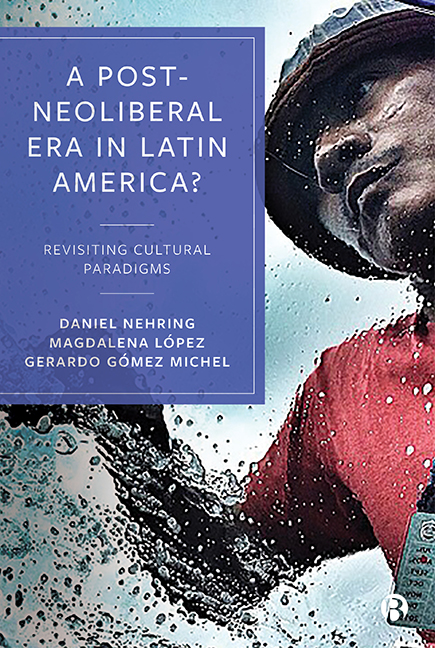
- A Post-Neoliberal Era in Latin America?Revisiting Cultural Paradigms, pp. 177 - 194Publisher: Bristol University PressPrint publication year: 2019
Accessibility standard: Unknown
Why this information is here
This section outlines the accessibility features of this content - including support for screen readers, full keyboard navigation and high-contrast display options. This may not be relevant for you.Accessibility Information
Accessibility compliance for the PDF of this chapter is currently unknown
and may be updated in the future.