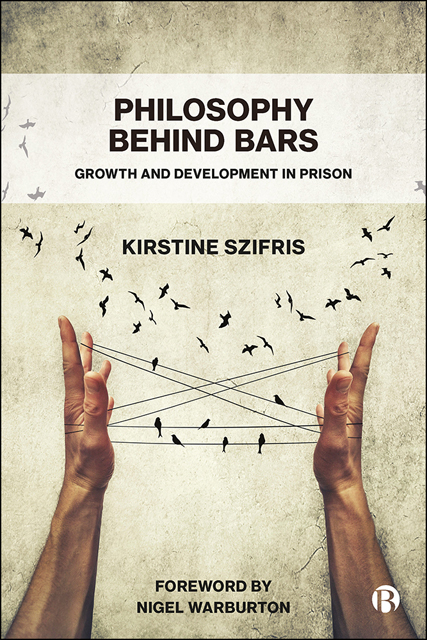
Book contents
- Frontmatter
- Dedication
- Contents
- List of Boxes
- Acknowledgements
- Foreword
- 1 Philosophy, Identity and the ‘Ship of Theseus’
- 2 Towards Theory: People, Places and Voices
- 3 Survival, Plato and the Ideal Society
- 4 Kant, Bentham and the Question of Identity
- 5 ‘Why Do You Think That?’ Descartes, Hume and Knowledge>
- 6 Not Just an Offender, But a Person
- 7 Trying to Find a Community of Philosophical Inquiry
- 8 Finding Trust and Developing Relationships
- 9 Personal Self-Exploration
- 10 Towards a Framework for Understanding Philosophy in Prison
- 11 Final Reflections
- Appendix: Technical Methods
- Bibliography
- Index
1 - Philosophy, Identity and the ‘Ship of Theseus’
Published online by Cambridge University Press: 15 April 2023

Book contents
- Frontmatter
- Dedication
- Contents
- List of Boxes
- Acknowledgements
- Foreword
- 1 Philosophy, Identity and the ‘Ship of Theseus’
- 2 Towards Theory: People, Places and Voices
- 3 Survival, Plato and the Ideal Society
- 4 Kant, Bentham and the Question of Identity
- 5 ‘Why Do You Think That?’ Descartes, Hume and Knowledge>
- 6 Not Just an Offender, But a Person
- 7 Trying to Find a Community of Philosophical Inquiry
- 8 Finding Trust and Developing Relationships
- 9 Personal Self-Exploration
- 10 Towards a Framework for Understanding Philosophy in Prison
- 11 Final Reflections
- Appendix: Technical Methods
- Bibliography
- Index
Summary
‘With philosophy you can bring out your own ideas and then, through the group you can rework it, remodel it, change it, look at it, to get to somewhere. So it's your part in building that and, I suppose, it's more empowering in that sense because you are doing it yourself.’ (Michael, HMP Grendon)
In the 1st century AD, Plutarch wrote of the ‘ship of Theseus’, a well-known philosophical paradox, revived by Thomas Hobbes and rearticulated over time by philosophers and teachers. The story provides a basis to discuss identity.
In Plutarch's story, Theseus was a hero who had sailed the oceans with great success. The people of Athens kept his ship in a harbour, as a museum piece, to honour his triumphs and to preserve it for future generations. To maintain the ship, they replaced old, broken pieces with fresh, new pieces. Eventually all the pieces of the ship were replaced, and the question became, ‘Is this still Theseus’ ship?’ According to Plutarch, half the philosophers of the day said it was, and the other half said it wasn’t.
The ship wherein Theseus and the youth of Athens returned from Crete had thirty oars, and was preserved by the Athenians down even to the time of Demetrius Phalereus, for they took away the old planks as they decayed, putting in new and stronger timber in their places, insomuch that this ship became a standing example among the philosophers, for the logical question of things that grow; one side holding that the ship remained the same, and the other contending that it was not the same. (Plutarch, ‘Theseus’, taken from The Rise and Fall of Athens: Nine Greek Lives, translated by Ian Scott-Kilvert, 1960)
In the 17th century, Thomas Hobbes resurrected the paradox of Theseus’ ship. He imagined a young sailor, too poor to buy his own ship, who took the old pieces and stowed them away. Eventually the young sailor had enough pieces to make his own ship out of the old pieces of Theseus’ ship. So now there were two ships. And the question became, ‘Which ship is Theseus’ ship?’
The story of Theseus’ ship, and the questions it raises, provided the basis of the opening philosophical discussion for an ‘Introduction to Philosophy’ class I delivered in two prisons in England during 2014 and 2015.
Information
- Type
- Chapter
- Information
- Philosophy behind BarsGrowth and Development in Prison, pp. 1 - 22Publisher: Bristol University PressPrint publication year: 2021
Accessibility standard: Unknown
Why this information is here
This section outlines the accessibility features of this content - including support for screen readers, full keyboard navigation and high-contrast display options. This may not be relevant for you.Accessibility Information
Accessibility compliance for the PDF of this chapter is currently unknown
and may be updated in the future.