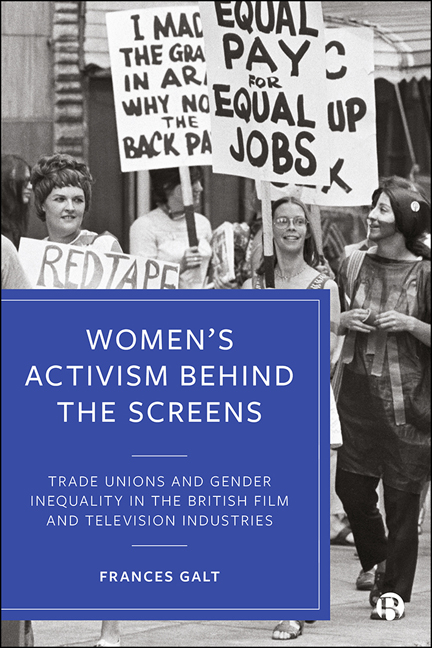
 Women's Activism Behind the Screens
 Trade Unions and Gender Inequality in the British Film and Television Industries
3 - ‘Regrettably Up-to-Date’, 1975–81
Published online by Cambridge University Press: 17 April 2021
Summary
The Patterns of Discrimination Against Women in the Film and Television Industries (hereafter Patterns) report by the ACTT was a seminal publication on gender discrimination in the workplace. Published in 1975, it was the product of a two-year investigation into gender discrimination in the British film and television industries conducted by the ACTT's Committee on Equality. The report illuminated widespread gender inequality by quantifying women workers’ experiences of discrimination and analysing the structures and attitudes that facilitated this discrimination within the industry, union, British state and society at large. Upon its publication the Patterns report was heralded as ‘by far the most comprehensive and informed to have been produced within the trade union movement so far’ by feminist film scholar and activist Claire Johnston (1975: 124–5). Women activists in the ACTT anticipated that the report's findings and recommendations would provoke radical change in the union's policies towards women workers. The report provided these women activists with concrete evidence of gender discrimination in both the industries and the union that could not be easily dismissed or disputed and would substantiate their future demands. Retrospectively reflecting on the Patterns report in oral history interviews carried out with the author, ACTT activist Sarah Boston described the conclusions of the report as “immense ammunition” (interview with the author, 7 July 2016), while the report's researcher, Sarah Benton, reasoned that Patterns ensured that women's experiences of gender discrimination “couldn't be dismissed as an anecdote” (interview with the author, 18 July 2016). At the ACTT's 1975 Annual Conference, Benton declared that the Patterns report marked ‘the beginning of the practical fight for women's rights’ (Anon, May 1975: 8). However, the relationship between women and the ACTT was instead characterized by inertia. Indeed, by the time of the ACTT's first Women's Conference six years later, in 1981, the Patterns report was described as ‘regrettably up-to-date’, indicating that little had changed (Skirrow, 1981: 94).
This chapter interrogates the inertia that followed the report's publication and, in doing so, identifies three reasons for slow progress around the implementation of its recommendations: the limited engagement of the ACTT's rank-and-file membership; the hostility of male union officials towards the report's demands, and the COE's detachment from the ACTT's formal union structure.
Information
- Type
- Chapter
- Information
- Women's Activism Behind the ScreensTrade Unions and Gender Inequality in the British Film and Television Industries, pp. 103 - 140Publisher: Bristol University PressPrint publication year: 2020
Accessibility standard: Unknown
Why this information is here
This section outlines the accessibility features of this content - including support for screen readers, full keyboard navigation and high-contrast display options. This may not be relevant for you.Accessibility Information
Accessibility compliance for the PDF of this chapter is currently unknown
and may be updated in the future.