Book contents
- Frontmatter
- Contents
- List of Figures and Tables
- Notes on Contributors
- Acknowledgements
- 1 Introduction: World Society and Its Histories – The Sociology and Global History of Global Social Change
- 2 Every Epoch, Time Frame or Date that Is Solid Melts into Air. Does It? The Entanglements of Global History and World Society
- 3 Periodization in Global History: The Productive Power of Comparing
- 4 Communication, Differentiation and the Evolution of World Society
- 5 Field Theory and Global Transformations in the Long Twentieth Century
- 6 Organization(s) of the World
- 7 Particularly Universal Encounters: Ethnographic Explorations into a Laboratory of World Society
- 8 From the First Sino-Roman War (That Never Happened) to Modern International-cum-Imperial Relations: Observing International Politics from an Evolution Theory Perspective
- 9 Nationalism as a Global Institution: A Historical-Sociological View
- 10 States and Markets: A Global Historical Sociology of Capitalist Governance
- 11 The Impact of Communications in Global History
- 12 The ‘Long Twentieth Century’ and the Making of World Trade Law
- 13 Third-Party Actors, Transparency and Global Military Affairs
- 14 Technical Internationalism and Global Social Change: A Critical Look at the Historiography of the United Nations
- References
- Index
1 - Introduction: World Society and Its Histories – The Sociology and Global History of Global Social Change
Published online by Cambridge University Press: 22 December 2021

Book contents
- Frontmatter
- Contents
- List of Figures and Tables
- Notes on Contributors
- Acknowledgements
- 1 Introduction: World Society and Its Histories – The Sociology and Global History of Global Social Change
- 2 Every Epoch, Time Frame or Date that Is Solid Melts into Air. Does It? The Entanglements of Global History and World Society
- 3 Periodization in Global History: The Productive Power of Comparing
- 4 Communication, Differentiation and the Evolution of World Society
- 5 Field Theory and Global Transformations in the Long Twentieth Century
- 6 Organization(s) of the World
- 7 Particularly Universal Encounters: Ethnographic Explorations into a Laboratory of World Society
- 8 From the First Sino-Roman War (That Never Happened) to Modern International-cum-Imperial Relations: Observing International Politics from an Evolution Theory Perspective
- 9 Nationalism as a Global Institution: A Historical-Sociological View
- 10 States and Markets: A Global Historical Sociology of Capitalist Governance
- 11 The Impact of Communications in Global History
- 12 The ‘Long Twentieth Century’ and the Making of World Trade Law
- 13 Third-Party Actors, Transparency and Global Military Affairs
- 14 Technical Internationalism and Global Social Change: A Critical Look at the Historiography of the United Nations
- References
- Index
Summary
Global social change: asking old questions anew
The aim of the present book is to prise open pertinent questions that need to be addressed when thinking about global social change. It assembles scholars from three disciplines: sociology, International Relations (IR) and history. We have not attempted to propose a single theoretical framework for analysing global social change, nonetheless we are convinced that we have reached a juncture in terms of thinking about global issues and their dynamics so that the time has come to seek cross-fertilizations between the various branches of global history, world society theories, global historical sociology, postcolonial studies, theories of International Relations and so forth. All these branches have emerged in criticism of disciplinary traditions, particularly in criticism of a ‘methodological nationalism’ not seen as fit for a comprehensive understanding of historical and contemporary global social orders and their dynamics. However, while they may have effectively delegitimized many old certainties and world views, they have been less successful in establishing a new paradigm.
The argument to be pursued in this book is that such a paradigm is most likely to emerge out of cross-disciplinary debates that make use of the empirical knowledge accumulated in globalization scholarship of recent decades; the book also re-examines the theoretical standpoints that guide the empirical work in different disciplines. All this requires openness to the knowledge and concepts that other disciplines bring to the table and consideration of varying traditions of thought and disciplinary contexts. Against this background, the aim of the book is to lay open some of the main questions (or problems) and issues (or topics) that have emerged as key entry points to the discussion about global social change in a vast body of scholarship. Many of the key questions of globalization research, such as periodization and ‘epochal’ change, or the meanings and implications of modernity, are by no means new. Quite the contrary. They are at the core most notably of history and sociology as academic disciplines. In addition, the field of IR, at the centre of its theoretical debates, has arguably always pondered on how to conceptualize change in world politics. It is reflection on precisely these core issues that promises to reveal the extent of work still to be done in seeking to reorient lines of thought that emerged in a decidedly national and colonial world to a global perspective.
Information
- Type
- Chapter
- Information
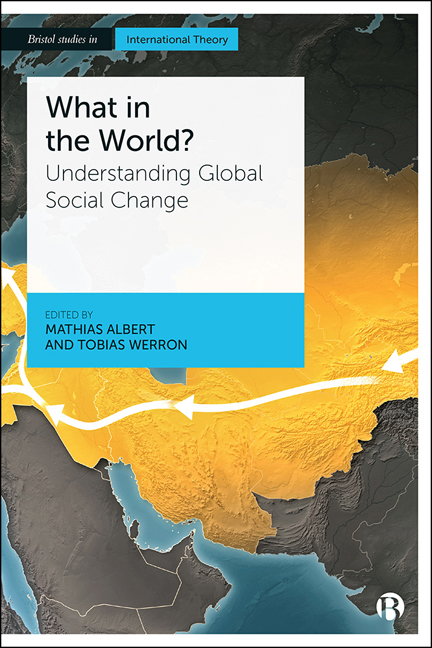
- What in the World?Understanding Global Social Change, pp. 1 - 24Publisher: Bristol University PressPrint publication year: 2020
Accessibility standard: Unknown
Why this information is here
This section outlines the accessibility features of this content - including support for screen readers, full keyboard navigation and high-contrast display options. This may not be relevant for you.Accessibility Information
Accessibility compliance for the PDF of this chapter is currently unknown
and may be updated in the future.
- 1
- Cited by