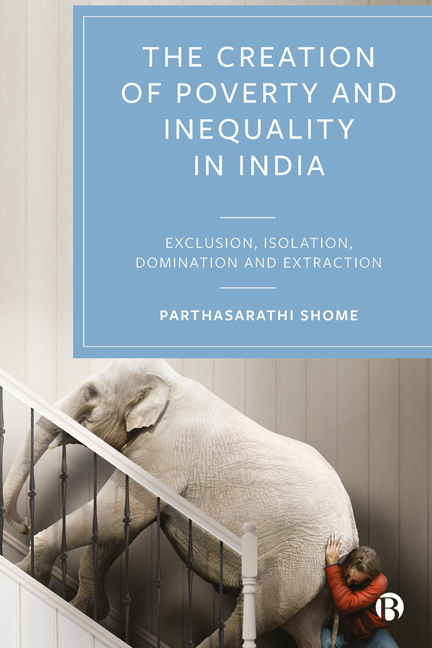
Book contents
- Frontmatter
- Dedication
- Contents
- List of Figures and Tables
- Preface
- 1 Introduction
- Part I Macro-Economy and Human Development
- Part II Sources of Inequality and Poverty
- Part III Sectoral Effects
- Part IV Radical Humanism
- Appendix 2.1 Cash Use in India: A Cross-Country Comparison
- Appendix 2.2 Macro-Economic Comparisons: Selected Economies
- Appendix 4.1 Selected Country Tables
- Appendix 5.1 Evidence on Inequality in the US
- Appendix 8.1 Impact of Land Policy
- Appendix 11.1 Impact of Asset Transfer on the Poor
- Index
Preface
Published online by Cambridge University Press: 18 January 2024

Book contents
- Frontmatter
- Dedication
- Contents
- List of Figures and Tables
- Preface
- 1 Introduction
- Part I Macro-Economy and Human Development
- Part II Sources of Inequality and Poverty
- Part III Sectoral Effects
- Part IV Radical Humanism
- Appendix 2.1 Cash Use in India: A Cross-Country Comparison
- Appendix 2.2 Macro-Economic Comparisons: Selected Economies
- Appendix 4.1 Selected Country Tables
- Appendix 5.1 Evidence on Inequality in the US
- Appendix 8.1 Impact of Land Policy
- Appendix 11.1 Impact of Asset Transfer on the Poor
- Index
Summary
Undertaking a study of the poor is fraught with the danger of exposing one's foolhardiness in attempting to deconstruct an intensely discussed yet unresolved area of human concern. Examining global poverty and poverty in India, it is clear that it is imperative to expand the understanding beyond a traditional economic approach and bring together diverse streams of thought and analyses, perhaps resulting in a Gordian's knot. For, when one broadens the investigative approach usually confined to a focus on micro-or macroeconomics to one that embraces anthropology, history and sociology in a geopolitical context, then the complexity of analysis intensifies. Analyses from various social sciences fields have to be employed, for confinement to a single approach would lead to misidentification of the genesis and incomplete or inadequate policy solutions. The knot has to be untangled to see what is found as the crux of the challenge of poverty and inequality so that commensurate policy interventions may be made.
This volume reveals what I found in my search. It reflects my attempt to pin down the prevalence of poverty and inequality, track them through time, and carry out a diagnostic of its genesis. I found the genesis in different bases or foundations in different societies. Only correct identification would lead to meaningful policy prescriptions and commensurate solutions for the eradication of poverty and redressal of inequality. While I make a series of international comparisons, the analysis, as it progresses, narrows down on India. The policy prescriptions for India should be relevant for developing countries generally.
Travel through the vast expanses of the globe leads an observer to encounter extreme poverty and its squalor and dehumanization in public places and to conclude that poverty has to be the deepest failure of humankind. This malaise has perverted India's development in particular. That poverty and extreme poverty continue to exist and are tightening their grip in significant pockets of the globe – in fact in every corner – in the twenty-first century is testimony to the persistence of that failure.
The challenging nature of any study on poverty and inequality has been succinctly expressed by investigators such as Gayatri Chakravorty Spivak and Partha Chatterjee who hypothesized that subalterns or the poorest are not heard for themselves because their voices tend to be represented by scholars, politicians or lawyers.
Information
- Type
- Chapter
- Information
- The Creation of Poverty and Inequality in IndiaExclusion, Isolation, Domination and Extraction, pp. x - xivPublisher: Bristol University PressPrint publication year: 2023
Accessibility standard: Unknown
Why this information is here
This section outlines the accessibility features of this content - including support for screen readers, full keyboard navigation and high-contrast display options. This may not be relevant for you.Accessibility Information
Accessibility compliance for the PDF of this chapter is currently unknown
and may be updated in the future.