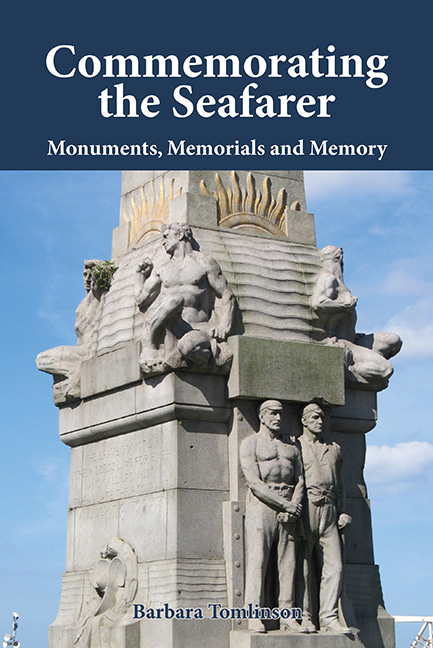
Book contents
- Frontmatter
- Dedication
- Contents
- Illustrations
- Preface
- Acknowledgements
- Introduction
- 1 Shifting Loyalties: Naval Memorials, 1628–783
- 2 The Age of Heroes: Naval Memorials, 1783–815
- 3 Pax Britannica: Naval Memorials, 1815–914
- 4 Stormy Weather: Conflict and Sacrifice in the Twentieth Century
- 5 Commerce and Philanthropy: Mercantile Commemoration
- 6 Lost at Sea: Maritime Accidents
- 7 Maritime Explorers: Drake to Shackleton
- 8 Inshore: Fishermen, Lifesavers and Leisure
- Conclusion
- Bibliography
- Index
Book contents
- Frontmatter
- Dedication
- Contents
- Illustrations
- Preface
- Acknowledgements
- Introduction
- 1 Shifting Loyalties: Naval Memorials, 1628–783
- 2 The Age of Heroes: Naval Memorials, 1783–815
- 3 Pax Britannica: Naval Memorials, 1815–914
- 4 Stormy Weather: Conflict and Sacrifice in the Twentieth Century
- 5 Commerce and Philanthropy: Mercantile Commemoration
- 6 Lost at Sea: Maritime Accidents
- 7 Maritime Explorers: Drake to Shackleton
- 8 Inshore: Fishermen, Lifesavers and Leisure
- Conclusion
- Bibliography
- Index
Summary
The author worked for thirty-five years at the National Maritime Museum, from which a preoccupation with specifically maritime material culture is inevitable. It can blind one to the bigger picture, in this case relationships between memorials to seafarers and to their shore-based contemporaries. I believe that I have managed to argue the case for specifically maritime examples as a rewarding subject for study. As with memorials in general, they have a good deal to say about collective values and their evolution reveals much about the democratization of personal identity. During my lifetime, the relationship between the nation and the sea has greatly changed. Since the Falklands Conflict, the sea as field of war has slipped out of British consciousness and containerization has moved ports away from city centres. A resulting lack of public awareness regarding matters maritime has become known as ‘sea blindness’. Interest in the coast and the sea itself as places to pursue adventure and spend leisure time continues.
There is also a growing interest in the sea as an environment. It has provided energy in the shape of North Sea oil, which has spawned its own disasters, notably the Piper Alpha fire. Now it is a site for offshore wind farms. All these activities are a source of employment and danger, although romance has yet to attach itself to wind farms. Love of hobbies has certainly been reflected in individual commemorative projects. Joshua Compston (d. 1996), an art dealer who liked messing about in boats, has a stone recumbent effigy in a dinghy at Kensal Green Cemetery, carved by Zebedee Helm: the quirky cemetery memorial continues to be commissioned. Charles Henry Rew (d. 1972), ‘angler and oarsman …’, has a commemorative window depicting the calling of fellow fisherman, St Peter, at the church of St Michel du Vale, Guernsey. The apostle is shown wearing a Guernsey sweater, trousers rolled-up.
There have also been general changes in funerary commemoration, mainly the separation of memorials and memorialization from the remains of the deceased. There is still a need for a special place for the bereaved to mourn and to communicate with the dead. Recent ways of providing this space have included plaques on seats in public places and unofficial, improvised shrines.
Information
- Type
- Chapter
- Information
- Commemorating the SeafarerMonuments, Memorials and Memory, pp. 231 - 234Publisher: Boydell & BrewerPrint publication year: 2015
Accessibility standard: Unknown
Why this information is here
This section outlines the accessibility features of this content - including support for screen readers, full keyboard navigation and high-contrast display options. This may not be relevant for you.Accessibility Information
Accessibility compliance for the PDF of this chapter is currently unknown
and may be updated in the future.