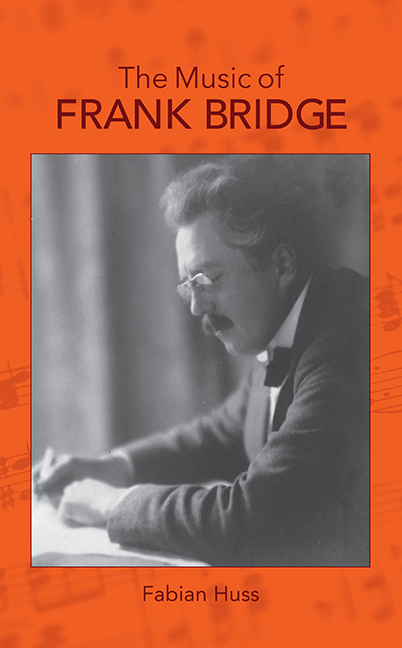
Book contents
- Frontmatter
- Contents
- List of Musical Examples
- Acknowledgments
- Introduction
- Chapter 1 Background, Royal College of Music and Early Works
- Chapter 2 First Maturity
- Chapter 3 Transitional Period
- Chapter 4 Bridge’s Post-Tonal Idiom: Piano Sonata and Third String Quartet
- Interlude Elizabeth Sprague Coolidge
- Chapter 5 Progressive Works, 1927–1932
- Interlude Benjamin Britten
- Chapter 6 Last Years
- List of Works
- Bibliography
- Index
Chapter 3 - Transitional Period
Published online by Cambridge University Press: 02 June 2021
Book contents
- Frontmatter
- Contents
- List of Musical Examples
- Acknowledgments
- Introduction
- Chapter 1 Background, Royal College of Music and Early Works
- Chapter 2 First Maturity
- Chapter 3 Transitional Period
- Chapter 4 Bridge’s Post-Tonal Idiom: Piano Sonata and Third String Quartet
- Interlude Elizabeth Sprague Coolidge
- Chapter 5 Progressive Works, 1927–1932
- Interlude Benjamin Britten
- Chapter 6 Last Years
- List of Works
- Bibliography
- Index
Summary
THE period after the retrospective works of 1912 is one of experimentation and stylistic expansion. This takes place primarily in the orchestral and piano music, genres whose direct expression and simple structural outlines were clearly felt to be more suitable to the exploration of new areas than the weighty forms and technical demands of chamber music, and the production of substantial chamber works is reduced noticeably during the experimental phase from 1913 to 1925. The increased emphasis on orchestral music further reflects Bridge's ambitions as a conductor, a strand of his career that continued to develop throughout this period, although it did not blossom fully in the way he had hoped.
One of the principal motivations in pursuing a career as a conductor was Bridge's desire to reduce his workload as an instrumentalist. As we saw in the previous chapter, his music benefited from the connections he made in this capacity, but he gradually became concerned that his prominence as a performer could taint the critical reception of his music, increasing the likelihood of its being seen as well written but lacking personality. In the intensifying modernism of Bridge's output, critics were prone to interpret elements of which they disapproved as renewed evidence of facility, a lack of backbone, and indeed of inferior expressiveness, as many contemporary critics held most modernism to be inherently inexpressive. Although he usually met such negative responses to his music with resignation, they could provoke his indignation, for instance here in his response to a 1921 Times Literary Supplement article that continued a growing trend of dismissive press:
If you read the notice carefully, you will see that I am only a composer of chamber music because I am a player! That players mostly play my things because they are nice to play – (not nice for those who listen) hence the reason that my name is so surprisingly common in programmes of English chamber music.
By this time, Bridge had already reduced his activities as a performer, not least due to the problem of image; his wife Ethel commented in a letter to Elizabeth Sprague Coolidge of the following year:
Information
- Type
- Chapter
- Information
- The Music of Frank Bridge , pp. 78 - 125Publisher: Boydell & BrewerPrint publication year: 2015
Accessibility standard: Unknown
Why this information is here
This section outlines the accessibility features of this content - including support for screen readers, full keyboard navigation and high-contrast display options. This may not be relevant for you.Accessibility Information
Accessibility compliance for the PDF of this chapter is currently unknown
and may be updated in the future.