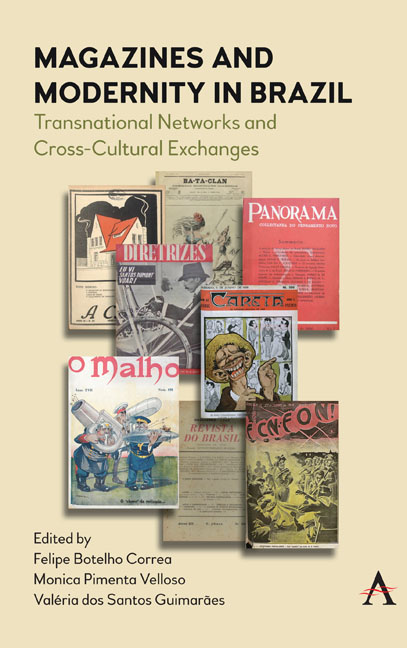
Book contents
- Frontmatter
- Contents
- List of Figures
- List of Contributors
- Introduction
- Chapter 1 The French Periodical Print Culture In Brazil: A Survey of Catalogues and Mediators (1800–1945)
- Chapter 2 The Transnational Model of Popular Illustrated Magazines: Three Case Studies from Brazil (1900–20)
- Chapter 3 The Transnational Networks of the Modernist Periodical Print Culture: The Magazine Lumière in the Aftermath of WWI
- Chapter 4 Versions of Modernity in the Household Magazine A Casa (1923– 45)
- Chapter 5 Panorama Magazine and the Far-Right in Brazil (1936–37)
- Chapter 6 Against Nazi-Fascism in Brazil: The Case of the Magazine Diretrizes (1938–44)
- Chapter 7 Literary Inquiries and Disputes on Global Modernism: the Debate in Brazil During WWII
- Chapter 8 Modernity and Modernisms in the Magazine Sombra (1940–60)
- Index
Chapter 1 - The French Periodical Print Culture In Brazil: A Survey of Catalogues and Mediators (1800–1945)
Published online by Cambridge University Press: 04 February 2022
Book contents
- Frontmatter
- Contents
- List of Figures
- List of Contributors
- Introduction
- Chapter 1 The French Periodical Print Culture In Brazil: A Survey of Catalogues and Mediators (1800–1945)
- Chapter 2 The Transnational Model of Popular Illustrated Magazines: Three Case Studies from Brazil (1900–20)
- Chapter 3 The Transnational Networks of the Modernist Periodical Print Culture: The Magazine Lumière in the Aftermath of WWI
- Chapter 4 Versions of Modernity in the Household Magazine A Casa (1923– 45)
- Chapter 5 Panorama Magazine and the Far-Right in Brazil (1936–37)
- Chapter 6 Against Nazi-Fascism in Brazil: The Case of the Magazine Diretrizes (1938–44)
- Chapter 7 Literary Inquiries and Disputes on Global Modernism: the Debate in Brazil During WWII
- Chapter 8 Modernity and Modernisms in the Magazine Sombra (1940–60)
- Index
Summary
The formation of a national public sphere in Brazil has been greatly influenced by cultural exchanges with French periodical print culture since the late eighteenth century. This influence was already evident even before the Francophonie gained global strength in the nineteenth century with the formation of a transnational media space in which Paris occupied a prominent place, due to its political and economic position. The context of this French influence among Brazilian intellectuals had a particular context, with the imperialist efforts of the French state often being obfuscated by the favourable reception of their ideas in the Portuguese colony, particularly within intellectuals circles.
One example of this early influence can be seen in the circulation of French periodicals in Brazil, which had already begun in the colonial period. Such a circulation had started even before the legalization of print activity and there are reports of the entry of the first Gazettes already at the end of the 1780s, in the context of the Carioca Conspiracy led by intellectuals from the Literary Society of Rio de Janeiro. Another example can be seen in the context of the Minas Gerais Conspiracy in the same decade, with the separatist movement of Vila Rica regarded as a ‘nest of poets’ greatly influenced by the ideas of the French Revolution. This intellectual influence was so important that some argue that Brazil had a literary sphere with creative intellectual productions even before the country developed commerce and industry and started its process of nation building.
If the early contacts with Europe were mediated mostly by Portuguese colonizers between the sixteenth and eighteenth centuries, by the late 1700s Paris had already become a major centre in the routes of cross-cultural exchanges of the Republic of Letters between Europe and the Americas. This community of scholars and literary figures that stretched across national boundaries often used French as their lingua franca in publications, including periodicals, that were printed not only in Paris but also in various other parts of the world.
The presence of Gazettes in Rio de Janeiro demonstrates the participation of Brazil in this transnational circulation of the written word, sometimes challenging the colonial barriers imposed by Portugal.
Information
- Type
- Chapter
- Information
- Magazines and Modernity in BrazilTransnational Networks and Cross-Cultural Exchanges, pp. 9 - 36Publisher: Anthem PressPrint publication year: 2020
Accessibility standard: Unknown
Why this information is here
This section outlines the accessibility features of this content - including support for screen readers, full keyboard navigation and high-contrast display options. This may not be relevant for you.Accessibility Information
Accessibility compliance for the PDF of this chapter is currently unknown
and may be updated in the future.