Book contents
- Frontmatter
- Contents
- List of Illustrations
- Acknowledgements
- Foreword
- Author's Note
- Map
- Introduction
- I The Early Years
- 1 Early Life
- 2 The Move to Dereham
- II Public Life
- 3 The Norfolk Clergy
- 4 Church Life
- 5 The Building Legacy
- 6 Schools
- 7 Town Life
- III Family and Friends
- 8 Family Life
- 9 Friends
- IV Later Life
- 10 The Later Years
- 11 Armstrong: A Man of His Time
- Bibliography
- Timeline
- Index
7 - Town Life
Published online by Cambridge University Press: 14 August 2020

Book contents
- Frontmatter
- Contents
- List of Illustrations
- Acknowledgements
- Foreword
- Author's Note
- Map
- Introduction
- I The Early Years
- 1 Early Life
- 2 The Move to Dereham
- II Public Life
- 3 The Norfolk Clergy
- 4 Church Life
- 5 The Building Legacy
- 6 Schools
- 7 Town Life
- III Family and Friends
- 8 Family Life
- 9 Friends
- IV Later Life
- 10 The Later Years
- 11 Armstrong: A Man of His Time
- Bibliography
- Timeline
- Index
Summary
No branch of the responsibilities of an English clergyman is more important than the duty of regularly, and at their houses, visiting his flock … he should mingle with them on the most intimate and social terms.
The Revd Benjamin Armstrong would have been a familiar figure in the town. In his dark frock coat, wide-brimmed hat and clerical collar he was to be seen visiting friends such as Mrs Gooch at Hill House and George Carthew in Quebec Street behind the Corn Hall, as well as the many houses of the ‘middling sort’ near the Market Place and the poor dwelling in the overcrowded yards. Further afield were the small terrace houses of the railway and industrial workers and beyond were the often squalid cottages of Toftwood, Badley Moor and Etling and Dumpling Green, all of which were regularly visited, particularly when their inhabitants were sick. These parishioners would also be encouraged to get infants baptised, children to school and older ones confirmed. There was also business to conduct and shops to be visited in the town. A typical morning was that of 29 April 1857:
To the Police Station about disorderly conduct of certain people on Sunday – to stone mason about legend to be inserted in St Withburga’s crypt, to plumber about some stained glass.
After this he returned home to write a piece for the local paper about the chancel restoration, prepare a testimonial for a young man from the school, which he then delivered, and in addition he gave instructions to the gardener. The next day he was in the town again to see his lawyer, Mr Cooper, about tithe arrangements.
Parish visiting
As well as the church and school, Armstrong listed amongst the duties of a clergyman ‘the poor’, and this was something he took very seriously. This diligent visiting was something that marked the Victorian clergy off from their perfunctory predecessors, and the involvement of lay (usually female) help was something growing in popularity. The General Society for Promoting of District Visiting was had begun in London in 1828 and by the 1830s lay visiting was recommended in the clergy handbooks. Samuel Best in 1839 encouraged the establishment of properly organised district visiting groups. In this way a ‘surveillance could be effected’ and ‘perfect order established’. The parson need only be called upon in special circumstances.
Information
- Type
- Chapter
- Information
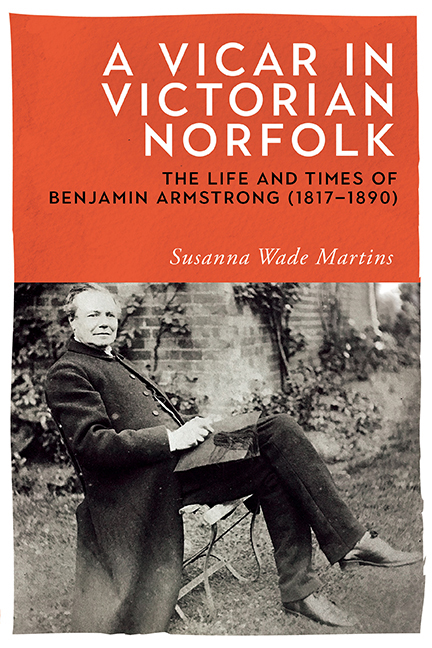
- A Vicar in Victorian NorfolkThe Life and Times of Benjamin Armstrong (1817–1890), pp. 163 - 190Publisher: Boydell & BrewerPrint publication year: 2018
Accessibility standard: Unknown
Why this information is here
This section outlines the accessibility features of this content - including support for screen readers, full keyboard navigation and high-contrast display options. This may not be relevant for you.Accessibility Information
Accessibility compliance for the PDF of this chapter is currently unknown
and may be updated in the future.