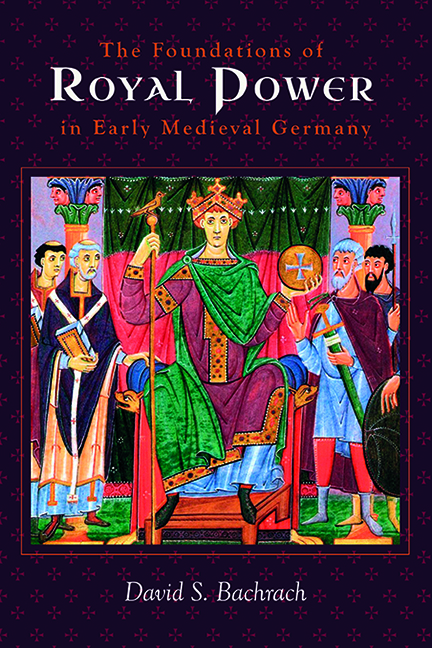
 The Foundations of Royal Power in Early Medieval Germany
 Material Resources and Governmental Administration in a Carolingian Successor State
Book contents
- Frontmatter
- Dedication
- Contents
- List of Illustrations
- Acknowledgments
- List of Abbreviations
- Maps
- Introduction
- 1 The Economy of Carolingian East Francia and Ottonian Germany
- 2 Material Assets of the Royal Fisc
- 3 Taxes, Tolls, and Other Regalian Rights
- 4 Ecclesiastical Resources at the Ruler’s Disposal
- 5 Toward an Analysis of Royal Expenditures: The Iter Regis and the Cost of Defense
- Conclusion
- Appendix 1 Fiscal Properties held by the Rulers of East Francia and Germany, 887–1106
- Appendix 2 Fortifications held by the Royal Government during the Reigns of Henry I and Otto I
- List of Key Terms
- List of Key Dates
- Bibliography
- Index
Appendix 2 - Fortifications held by the Royal Government during the Reigns of Henry I and Otto I
Published online by Cambridge University Press: 16 July 2022

Book contents
- Frontmatter
- Dedication
- Contents
- List of Illustrations
- Acknowledgments
- List of Abbreviations
- Maps
- Introduction
- 1 The Economy of Carolingian East Francia and Ottonian Germany
- 2 Material Assets of the Royal Fisc
- 3 Taxes, Tolls, and Other Regalian Rights
- 4 Ecclesiastical Resources at the Ruler’s Disposal
- 5 Toward an Analysis of Royal Expenditures: The Iter Regis and the Cost of Defense
- Conclusion
- Appendix 1 Fiscal Properties held by the Rulers of East Francia and Germany, 887–1106
- Appendix 2 Fortifications held by the Royal Government during the Reigns of Henry I and Otto I
- List of Key Terms
- List of Key Dates
- Bibliography
- Index
Summary
This appendix is organized in three sections. In the first section, I have listed in alphabetical order the fortifications that can be identified in royal possession on the basis of attestations in written sources produced during the reigns of Henry I and Otto I. In the second section, I have listed alphabetically the fortifications that are attested in documents after Otto I's reign that meet the following criteria. The fortifications were located in regions that were either held or conquered by Henry I or Otto I, and in regions that remained under royal control up through the twelfth century. In the third section, I have listed alphabetically those fortifications that do not appear in the written record from the tenth to the twelfth century, but which have been identified by scholars as either German, or specifically Ottonian fortified centers, dating to the tenth century in regions that were conquered by Henry I or Otto I. Place-names are all given in their standard German forms, where these are known. Otherwise, they are listed as they appear in contemporary documents.
Part I: Written attestations of fortifications in the possession of Henry I or Otto I in the period 919–973
Fortification total = 57
Allstedt (DO I, §5); Beneduces (DO I, §209); Biederitz (DO I, 1§05); Brandenburg (DO I, §105); Buckau (DO I, §14); Burg (DO I, §105); Calbe (DO III, §118); Chur (DO I, §191); Dahlum (DO I, §5); Debrogora (DO I, §152); Deventer (DO I, §152); Dornburg (DO I, §18); Drübeck (DO I, §56); Duisburg (DO I, §66) Eilenburg (DO I, §231); Elten (DO I, §358) Frohse (DO I, §14); Gebiechenstein (DO I, §232); Gommern (DO I, §105); Grabo (DO I, §105); Grodista (DO I, §152); Grone (DO I, §16); Halle (DO I, §231); Havelberg (DO I, §76); Kirchberg (DO I, §18); Krapfeld (DO I, §171); Landsberg (DO I, §231); Laublingen (DO I, §231); Leibnitz (DO I, §389); Löbejün (DO I, §231); Lobodunburg (DO I, §161); Loburg (DO I, §293); Lostau (DO II, §30); Magdeburg (DO I, §14); Memleben (DO I, §48); Merseburg (DO I, §1); Möckern (DO I, §105); Nitzow (DO I, §76); Pechau ( DO I, §105); Plot (DO I, §76); Pochlustim (DO I, §76); Pritzerbe (DO I, §105); Roseburg (DO I, §278); Rothenburg (DO I, §230); Saalfeld (DO I, §49); Schartau (DO I, §105); Spielberg (DO I, §172); Suib (DO I, §389);
Information
- Type
- Chapter
- Information
- The Foundations of Royal Power in Early Medieval GermanyMaterial Resources and Governmental Administration in a Carolingian Successor State, pp. 293 - 300Publisher: Boydell & BrewerPrint publication year: 2022
Accessibility standard: Unknown
Why this information is here
This section outlines the accessibility features of this content - including support for screen readers, full keyboard navigation and high-contrast display options. This may not be relevant for you.Accessibility Information
Accessibility compliance for the PDF of this chapter is currently unknown
and may be updated in the future.