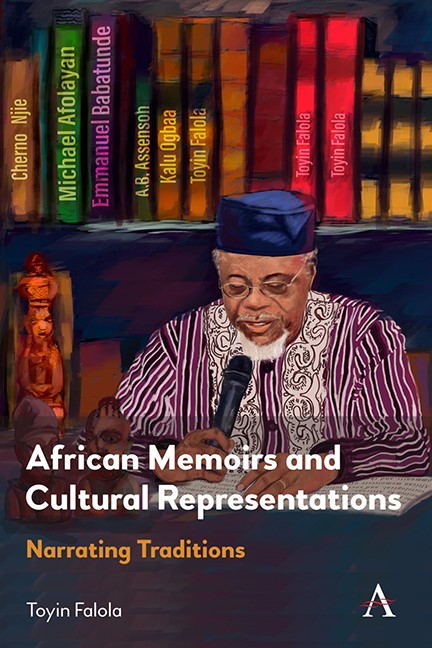
Book contents
- Frontmatter
- Contents
- List of Figures
- Dedication
- Acknowledgments
- Preface
- Chapter One Mirror Effect: Narrating the Self through Traditions and Cultures
- Chapter Two The Universal and the Particular in African Memoirs
- Chapter Three The Portraiture of Womanhood in Emmanuel Babatunde’s An African Journey through Celibate Priesthood to Married Life
- Chapter Four Politics, Philosophical Representation, and Culture in Cherno Njie’s Sweat Is Invisible in the Rain
- Chapter Five The Yoruba Worldview, Meanings, and Ideals of Life in Michael Afolayan’s Fate of Our Mothers
- Chapter Six The Indelibility of Igbo Tradition (Home) in Kalu Ogbaa’s Carrying my Father’s Torch
- Chapter Seven Experiences, Reflections, and Refractions on the Cusp in A. B. Assensoh’s A Matter of Sharing
- Chapter Eight Toward a Spatial and Identity Synthesis: Regional Peculiarities in African Memoirs
- Bibliography
- Index
Chapter Four - Politics, Philosophical Representation, and Culture in Cherno Njie’s Sweat Is Invisible in the Rain
Published online by Cambridge University Press: 14 November 2023
Book contents
- Frontmatter
- Contents
- List of Figures
- Dedication
- Acknowledgments
- Preface
- Chapter One Mirror Effect: Narrating the Self through Traditions and Cultures
- Chapter Two The Universal and the Particular in African Memoirs
- Chapter Three The Portraiture of Womanhood in Emmanuel Babatunde’s An African Journey through Celibate Priesthood to Married Life
- Chapter Four Politics, Philosophical Representation, and Culture in Cherno Njie’s Sweat Is Invisible in the Rain
- Chapter Five The Yoruba Worldview, Meanings, and Ideals of Life in Michael Afolayan’s Fate of Our Mothers
- Chapter Six The Indelibility of Igbo Tradition (Home) in Kalu Ogbaa’s Carrying my Father’s Torch
- Chapter Seven Experiences, Reflections, and Refractions on the Cusp in A. B. Assensoh’s A Matter of Sharing
- Chapter Eight Toward a Spatial and Identity Synthesis: Regional Peculiarities in African Memoirs
- Bibliography
- Index
Summary
Introduction
Human early life is characterized by experiences that shape ideation and principles that carve pathways that people tend to follow later in life. In essence, human outcome is a function of many factors, one of which is social interaction and conditioning. The continental African is a construct of ancient and modern cultures, belief systems, epistemologies, and philosophies that shape his or her opinion, interaction, and disposition toward life. Also, irrespective of the glaring diversities and complexities of the African continent, some philosophies and value systems constitute an area of commonality between nations. These philosophies, ideologies, and values have impacted various aspects of African society, and they should ideally influence systems and structures like politics and the economy extensively and positively.
However, concerning the underdeveloped status of the continent against the rest of the globe and the dreadful track record of politics and government in postcolonial Africa, this study propounds the idea that the continent’s politics operate on a misrepresentation of ancient indigenous philosophies. This conception will be extensively explored in subsequent sections of this work. It will also analyze and provide textual evidence from Cherno Njie’s memoir, Sweat Is Invisible in the Rain.
With reference to Njie’s text, the need to explain or clarify complex aspects of self and actions has driven many into the art of writing. In other words, several literary genres have emanated from the single need for expression, the urge to tell one’s story. In the memoir, Raab buttresses this notion by stating that “many memoir writers choose this genre as a way to find or reclaim their voice, share a family secret, or tell a story.” Cherno Njie’s Sweat is Invisible in the Rain is one of those literary publications, a memoir at best, that tries to capture time and history in print, to explain motivations for actions not fully understood by many, and to clarify misconceptions that might have arisen from a singular act of patriotism. For the writer, the text is a product of introspection, a clarification, a tale of tyranny and bravery, and the unveiling of fallen and living heroes.
African Culture and Philosophy in Sweat Is Invisible in the Rain
The African principles of contentment, tolerance, humanity, honor, and communitarianism cut across several regions of the continent and are often reflected in the proverbs and sayings of the African people.
Information
- Type
- Chapter
- Information
- African Memoirs and Cultural RepresentationsNarrating Traditions, pp. 71 - 90Publisher: Anthem PressPrint publication year: 2023
Accessibility standard: Unknown
Why this information is here
This section outlines the accessibility features of this content - including support for screen readers, full keyboard navigation and high-contrast display options. This may not be relevant for you.Accessibility Information
Accessibility compliance for the PDF of this chapter is currently unknown
and may be updated in the future.