Book contents
- Frontmatter
- Contents
- Tables
- Dedication
- Preface
- Acknowledgements
- Abbreviations
- 1 Domesday Past and Present
- 2 The Domesday Texts
- 3 The Inquest and the Book
- 4 The Domesday Boroughs
- 5 Lordship, Land, and Service
- 6 The Vill and Taxation
- 7 The Economy and Society
- 8 The Communities of the Shire
- 9 The Beyond of Domesday
- 10 Domesday Now
- Appendix The main entry forms of GDB
- Bibliography
- Index
1 - Domesday Past and Present
Published online by Cambridge University Press: 10 March 2023

Book contents
- Frontmatter
- Contents
- Tables
- Dedication
- Preface
- Acknowledgements
- Abbreviations
- 1 Domesday Past and Present
- 2 The Domesday Texts
- 3 The Inquest and the Book
- 4 The Domesday Boroughs
- 5 Lordship, Land, and Service
- 6 The Vill and Taxation
- 7 The Economy and Society
- 8 The Communities of the Shire
- 9 The Beyond of Domesday
- 10 Domesday Now
- Appendix The main entry forms of GDB
- Bibliography
- Index
Summary
It is unlikelythat Domesday Book will ever join the Bible and Shakespeare as an indispensable companion of the castaway marooned on a desert island. Nonetheless in one way or another it is a cultural icon of equal power in English consciousness. For many today that power is all but subliminal. ‘Domesday’ is nowadays most often used as a tabloid term for any comprehensive list with pretensions to permanent record. We have had the BBC Domesday of 1986 (sadly unreadable after twenty years of technological advance), a Domesday of the government art collection, a Domesday of village greens, even a Domesday of rap. No one has to read on to find out the nature of the enterprise in question. The Domesday Book may often be dimly perceived. Its most common outing is in estate agents’ descriptions as an imprimatur of heritage. The very name, though, conjures up ideas that lie at the heart of the Christian inheritance. Domesday Book is the embodiment of final authority.
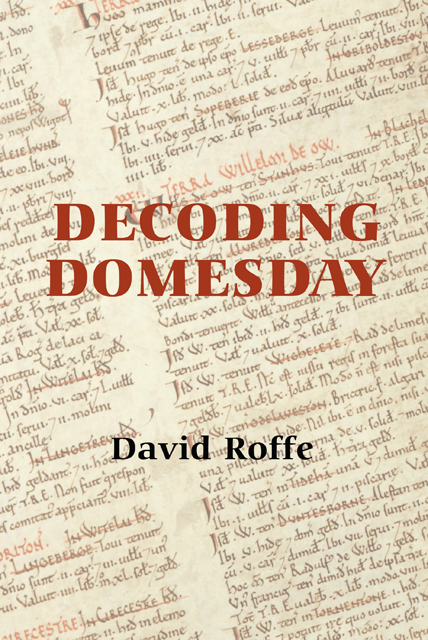
Apart from its obvious antiquity, the reality might disappoint the more apocalyptically minded. Domesday Book is preserved in the National Archives in Kew, London, where it is on display in the museum as the oldest and most precious of the English public records. It is an abstract of a survey of lords, lands, and taxes ordered by William the Conqueror at the Christmas court at Gloucester in 1085. In fact, it is not one book but two. Volume one, known as Great Domesday Book (GDB), is an account of thirty-one of the thirty-four shires of Norman England; volume two, Little Domesday Book (LDB), is concerned with the remaining three. The language of both is Latin and it is highly contracted into a business-like shorthand. GDB is an accomplished production. It is written in two columns in neat Carolingian minuscules, the current form of writing in the eleventh century, on 382 folios (764 pages) fifteen by eight inches, and attention is drawn to importantitems of information such as the names of manors by capitalization and throughlining or shading (rubrication) in red ink.
Information
- Type
- Chapter
- Information
- Decoding Domesday , pp. 1 - 28Publisher: Boydell & BrewerPrint publication year: 2015
Accessibility standard: Unknown
Why this information is here
This section outlines the accessibility features of this content - including support for screen readers, full keyboard navigation and high-contrast display options. This may not be relevant for you.Accessibility Information
Accessibility compliance for the PDF of this chapter is currently unknown
and may be updated in the future.