Book contents
- Frontmatter
- Dedication
- Contents
- List of tables and figures
- Acknowledgements
- About the authors
- Introduction
- one Why wealth matters
- two Why the wealthy matter
- three What is wealth and who are the wealthy?
- four The distribution of wealth
- five The rich, the richer and the richest
- six Towards a comprehensive policy on assets
- seven Social policy and the wealthy
- Conclusions
- References
- Index
one - Why wealth matters
Published online by Cambridge University Press: 01 September 2022

Book contents
- Frontmatter
- Dedication
- Contents
- List of tables and figures
- Acknowledgements
- About the authors
- Introduction
- one Why wealth matters
- two Why the wealthy matter
- three What is wealth and who are the wealthy?
- four The distribution of wealth
- five The rich, the richer and the richest
- six Towards a comprehensive policy on assets
- seven Social policy and the wealthy
- Conclusions
- References
- Index
Summary
Introduction
Wealth in the form of personal assets has received increasing attention in recent years from researchers and policy makers. This is for two main reasons. First, in the UK there has been an increase in policy emphasis on personal asset holding since the 1980s and a growing proportion of the population now own some kind of personal wealth. For example, 70 per cent of households are owner-occupied. This shift has been the result of deliberate policy change, from 1979 onwards, aimed at reducing state provision of welfare and collective ownership of wealth. We have seen this in the state withdrawing from providing social housing and instead encouraging people to become home owners. The state has also reduced levels of entitlement to the state retirement pension and encouraged people to take out their own private pensions – although the success of this policy has not been as great as with home ownership. And the state has privatised a number of industries and companies, selling off shares to individuals. This decline in the collective ownership of wealth and the corresponding rise in personal asset holding is part of a broader shift from collective forms of responsibility and risk through the state to more individual forms of responsibility and risk. These are significant trends, affecting the lives of us all. They demand analysis of the causes, consequences and policy implications of such trends as while some people have benefited from these trends, others have been left behind.
The second reason for social policy to focus on assets as well as income is that income is not the only important economic resource. It certainly plays a vital role in relation to people's livelihoods, but assets play their part. Some research suggests that assets have a positive effect on people, independent from income, and if this is the case, then social policy should not only concern itself with discussing ways of increasing incomes for those in poverty but also ways of increasing their assets.
This chapter discusses each of these reasons in more detail.
From collective welfare to individual assets
The year 1979 was a major turning point in British history. The new Conservative government hit the ground running with a range of policies designed to ‘roll back the frontiers of the state’.
Information
- Type
- Chapter
- Information
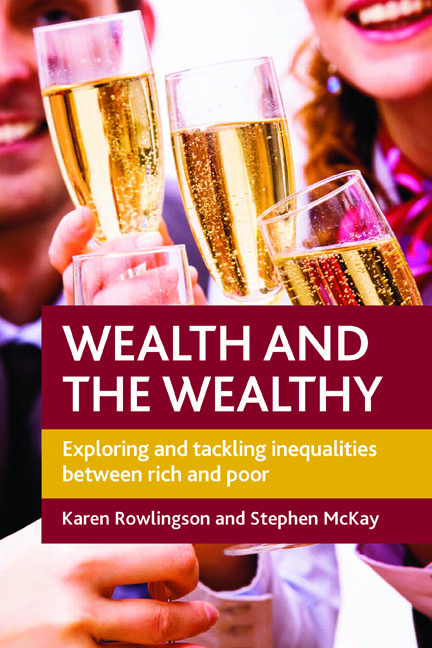
- Wealth and the WealthyExploring and Tackling Inequalities between Rich and Poor, pp. 1 - 18Publisher: Bristol University PressPrint publication year: 2011
Accessibility standard: Unknown
Why this information is here
This section outlines the accessibility features of this content - including support for screen readers, full keyboard navigation and high-contrast display options. This may not be relevant for you.Accessibility Information
Accessibility compliance for the PDF of this chapter is currently unknown
and may be updated in the future.