Book contents
- Frontmatter
- Dedication
- Contents
- List of tables
- Preface
- Introduction
- one The network governance milieu
- two Network governance policy
- three The limits of network governance
- four Beyond the transformation thesis
- five From network governance to hegemony
- six Gramscian governance research
- seven Conclusion
- References
seven - Conclusion
Published online by Cambridge University Press: 07 September 2022

Book contents
- Frontmatter
- Dedication
- Contents
- List of tables
- Preface
- Introduction
- one The network governance milieu
- two Network governance policy
- three The limits of network governance
- four Beyond the transformation thesis
- five From network governance to hegemony
- six Gramscian governance research
- seven Conclusion
- References
Summary
The wider context for the Marxist-Gramscian perspective developed in this book is what Callinicos (2007b, p 345) sees as the changing of the subject away from postmodernism back towards capitalism, class and resistance – themes that the transformation thesis dismissed amid the crisis of Marxism, the global capitalist renaissance and its fetish for networks. The purpose, therefore, has been to show how the Marxist and Gramscian traditions are relevant in rethinking governance today. Harvey comments that although postmodernism promised aesthetic emancipation, working with the grain of capital accumulation meant that its initially spectacular designs soon took on a predictably monotonous quality (cited in Merrifield, 2002, p 150). Similarly, post-traditional faith in the transformative quality of networks founders in the face of ‘governance as usual’. Connectionist ideology lent vision and promise to the global capitalist renaissance, transposed by governments into the language of opportunity and inclusion and strategies for cultivating governance networks. This is the vision that founders as creeping governmentalisation trumps connectionism, amid more or less overt recalcitrance among distrusting civil society insiders and burgeoning crisis and resistance elsewhere in the social system.
Consequently, what is different about the past 40 years or so is not so much de-traditionalisation, dispersion and the rise of the network society, as the celebration of networks spearheading neoliberalism. Gramscian concepts, particularly the hegemonic project, the historic bloc, passive revolution and the integral state can contribute much to our understanding of the connectionist conjuncture as a moment in the struggle for hegemony. This struggle takes place on the terrain of the integral state, the dialectics of coercion–consent enacted in the day-to-day politics of institutions like governance networks. The idea of a contradictory totality central to Marxism is not a theory of ‘final suture’ as Laclau and Mouffe (2001, p 125) argued but of its impossibility, which is why hegemony is a relentless struggle and coercion remains the inescapable condition of consent. The neoliberal struggle has been partly about the shock doctrine and expanding markets, but also about transforming and enrolling civil society, attempting to cultivate the connectionist ethos.
In some cases this strategy may have succeeded in enrolling civil society activists, but in many others the dialectics of the integral state clearly undermine it.
Information
- Type
- Chapter
- Information
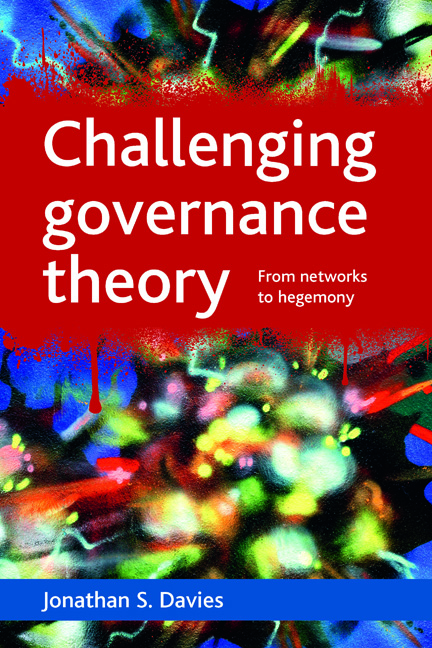
- Challenging Governance TheoryFrom Networks to Hegemony, pp. 151 - 156Publisher: Bristol University PressPrint publication year: 2011
Accessibility standard: Unknown
Why this information is here
This section outlines the accessibility features of this content - including support for screen readers, full keyboard navigation and high-contrast display options. This may not be relevant for you.Accessibility Information
Accessibility compliance for the PDF of this chapter is currently unknown
and may be updated in the future.