Book contents
- Frontmatter
- Dedication
- Contents
- Acknowledgements
- one Introduction
- two Housing policy and disabled people: from past to present
- three Understanding disability: from ‘personal tragedy’ to social disadvantage
- four Physical and communication barriers: the built environment and access to information
- five Financial considerations: income, affordability and risk assessment
- six Attitudinal constraints: assumptions and institutional practices
- seven Creating the ‘home’ in a society of barriers
- References
- Websites
- Index
one - Introduction
Published online by Cambridge University Press: 07 September 2022

Book contents
- Frontmatter
- Dedication
- Contents
- Acknowledgements
- one Introduction
- two Housing policy and disabled people: from past to present
- three Understanding disability: from ‘personal tragedy’ to social disadvantage
- four Physical and communication barriers: the built environment and access to information
- five Financial considerations: income, affordability and risk assessment
- six Attitudinal constraints: assumptions and institutional practices
- seven Creating the ‘home’ in a society of barriers
- References
- Websites
- Index
Summary
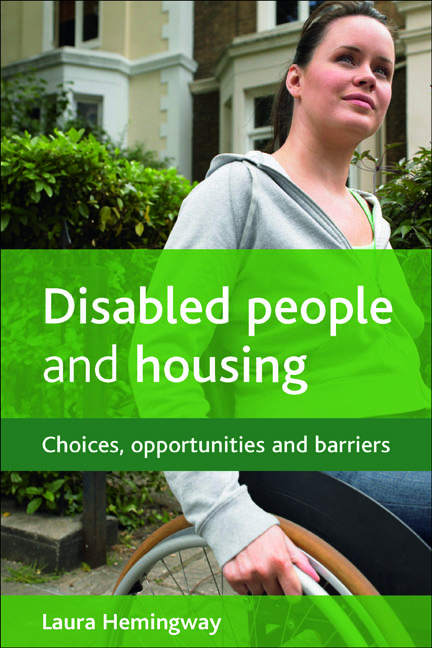
This book examines housing issues, policies and practices relating to disabled people, and explores available choices, opportunities and barriers in the field. The focus is on disabled people's acquisition of, or access to, accommodation, and how individuals experience housing. We will see how housing options and pathways can be constrained, conditioned and assisted by a range of actors, institutions and practices. With regard to disabled people's experiences, the book will show how housing can be a place of independence, control and security, or (if inaccessible or unsuitable) how it can restrict an individual and their family, leading to dependency and negatively affecting lifestyle choices. While other variables are clearly significant for daily living – including financial position, household composition and available support – the dwelling itself plays a vital role in people's lives. As such, although housing circumstances are significant elements of life for everybody, for disabled people they can be especially crucial in the achievement of independent living.
In reviewing the roles of the home, we should not separate the dwelling from its socio-economic contexts. There has been a tendency for housing providers and professionals to concentrate on physical factors when considering disabled people's housing needs, and while these are extremely significant, such a focus may neglect social and financial issues, which may be just as important for some residents. One idea underpinning this book is the need to see the housing settings and needs of households in holistic ways. This theme is especially evident in the later chapters where we look at the various aspects of housing affecting disabled people's opportunities that can be identified from a broadly social approach to understanding disability. These include aspects of housing design and construction (especially the general accessibility and adaptability of the physical environment), the availability and presentation of information on housing options, the economic factors that affect access to housing (including general affordability and ability to secure housing finance) and the role of ‘actors’ involved in the process of building, selling and allocating housing. Thus, we see how disabled people's choices and opportunities within housing may be restricted by barriers that can be categorised as physical, attitudinal, financial and related to communication.
Information
- Type
- Chapter
- Information
- Disabled People and HousingChoices, Opportunities and Barriers, pp. 1 - 18Publisher: Bristol University PressPrint publication year: 2011
Accessibility standard: Unknown
Why this information is here
This section outlines the accessibility features of this content - including support for screen readers, full keyboard navigation and high-contrast display options. This may not be relevant for you.Accessibility Information
Accessibility compliance for the PDF of this chapter is currently unknown
and may be updated in the future.