Book contents
- Seeking Asylum and Mental Health
- Seeking Asylum and Mental Health
- Copyright page
- Contents
- The Authors
- Foreword
- Acknowledgements
- Glossary
- Introduction
- 1 Why do people seek asylum? The global context
- 2 Seeking asylum in the United Kingdom
- 3 Seeking asylum and mental health
- 4 Access to mental health care
- 5 Assessing mental health needs
- 6 Interpreting assessment findings
- 7 Formulation and diagnosis
- 8 Common diagnoses
- 9 Intervention: the essentials
- 10 Specific interventions
- 11 Children, families, and young people
- 12 Records and reports
- 13 Improving mental health services
- 14 Therapeutic complexity
- 15 Working with people seeking asylum
- Some resources
- Index
- References
6 - Interpreting assessment findings
Published online by Cambridge University Press: 26 August 2022
Book contents
- Seeking Asylum and Mental Health
- Seeking Asylum and Mental Health
- Copyright page
- Contents
- The Authors
- Foreword
- Acknowledgements
- Glossary
- Introduction
- 1 Why do people seek asylum? The global context
- 2 Seeking asylum in the United Kingdom
- 3 Seeking asylum and mental health
- 4 Access to mental health care
- 5 Assessing mental health needs
- 6 Interpreting assessment findings
- 7 Formulation and diagnosis
- 8 Common diagnoses
- 9 Intervention: the essentials
- 10 Specific interventions
- 11 Children, families, and young people
- 12 Records and reports
- 13 Improving mental health services
- 14 Therapeutic complexity
- 15 Working with people seeking asylum
- Some resources
- Index
- References
Summary
When assessing people from very different backgrounds who have had complicated and challenging life experiences, mental health professionals need to be wary of jumping to wrong conclusions.
With people seeking asylum, interpreting appearance, behaviour and non-verbal communication is likely to be harder than usual. Narrative style and autobiographical memory aresubject to diverse influences that include attachment security and autobiographical competence, emotional distress, external prompts and context, social identity, and culture. Major adversity and PTSDcan result in complex difficulties in giving clear consistent accounts. Neurodevelopmental diversity and intellectual disabilities present specific challenges. People seeking asylum also face some narrative dilemmas particular to their situation.
The outcome of an asylum claim often hinges on judgements about a person’s credibility.While determining credibility is the responsibility of the Home Office and courts, mental health professionals can contribute to good decision-making by offering clinical explanations for features of a person’s account or behaviour that have been used to cast doubt on their credibility.
Keywords
Information
- Type
- Chapter
- Information
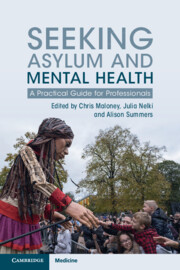
- Seeking Asylum and Mental HealthA Practical Guide for Professionals, pp. 116 - 131Publisher: Cambridge University PressPrint publication year: 2022
References
Further reading
There is a wealth of further discussion of some of the issues raised in this chapter, and other resources, available on the website of the Centre for the Study of Emotion and Law, based at Royal Holloway University: http://pc.rhul.ac.uk/sites/csel/research-hub/
References
Abbas, P., von Werthern, M., Katona, C., and Brady, F. (2020). The texture of narrative dilemmas: Qualitative study in front-line professionals working with asylum seekers in the UK. BJPsych Bulletin, 45(1): 1–7.Google Scholar
American Psychiatric Association (2013). Diagnostic and Statistical Manual of Mental Disorders, Fifth Edition [DSM5]. Washington DC and London: American Psychiatric Publishing.Google Scholar
Dudas, R. B., Lovejoy, C., Cassidy, S., Allison, C., Smith, P., and Baron-Cohen, S. (2017). The overlap between autistic spectrum conditions and borderline personality disorder. PLoS ONE, 12(9): e0184447. https://doi.org/10.1371/journal.pone.0184447.CrossRefGoogle ScholarPubMed
Ehlers, A. and Clark, D. M. (2000). A cognitive model of persistent PTSD. Behaviour Research and Therapy, 38: 19–45.Google Scholar
Evans Cameron, H. (2010). Refugee Status Determinations and the Limits of Memory. International Journal of Refugee Law, 22(4): 469–511.CrossRefGoogle Scholar
Flor, H., and Nees, F. (2014). Learning, memory and brain plasticity in posttraumatic stress disorder: Context matters. Restorative Neurology and Neuroscience, 32(1): 95–102. https://doi.org/10.3233/RNN-139013.CrossRefGoogle ScholarPubMed
Hellawell, S. J. and Brewin, C. R. (2002). A comparison of flashbacks and ordinary autobiographical memories of trauma: Cognitive resources and behavioural observations. Behaviour Research and Therapy, 40(10): 1143–56.CrossRefGoogle ScholarPubMed
Herlihy, J. (2014). Psychological Barriers to Fair Refugee Status Determination Related to Our Understanding and Expression of Gender. In Arbel, E., Dauvergne, C., and Millbank, J. (Eds.), Gender in Refugee Law: From the Margins to the Centre (pp. 116–37). Abingdon: Routledge.Google Scholar
Herlihy, J., Gleeson, K., and Turner, S. (2010). What assumptions about human behaviour underlie asylum judgments? International Journal of Refugee Law, 22(3): 351–66.CrossRefGoogle Scholar
Herlihy, J., Scragg, P., and Turner, S. (2002). Discrepancies in autobiographical memories – implications for the assessment of asylum seekers: Repeated interviews study. British Medical Journal, 324, 324–7Google Scholar
Home Office (2015). Asylum Policy Instruction: Assessing Credibility and Refugee Status. Version 9.0, https://assets.publishing.service.gov.uk/government/uploads/system/uploads/attachment_data/file/397778/ASSESSING_CREDIBILITY_AND_REFUGEE_STATUS_V9_0.pdf.Google Scholar
Hook, A. and Andrews, B. (2005). The relationship of non-disclosure in therapy to shame and depression. British Journal of Clinical Psychology, 44: 425–38.CrossRefGoogle ScholarPubMed
List, J. A. (1986). Age and schematic differences in reliability of eyewitness testimony. Developmental Psychology, 22: 50–7.Google Scholar
Pelosi, L., Slade, T., Blumhardt, L. D., and Sharma, V. K. (2000). Working memory dysfunction in major depression; an event-related potential study. Clinical Neurophysiology, 111: 1531–43.Google Scholar
Rogers, H., Fox, S., and Herlihy, J. (2015). The importance of looking credible: The impact of the behavioural sequelae of post-traumatic stress disorder on the credibility of asylum seekers. Psychology, Crime and Law, 21: 139–55. http://dx.doi.org/10.1080/1068316X.2014.951643Google Scholar
Trani, J-F., Babulal, G. M., and Bakhshi, P. (2015). Development and validation of the 34-Item disability screening questionnaire (DSQ-34) for use in low and middle income countries epidemiological and development surveys. PLoS One, 10 (12): e0143610. https://digitalcommons.wustl.edu/open_access_pubs/4424CrossRefGoogle ScholarPubMed
Van der Kolk, B. A. and Fisler, R. (1995). Dissociation and the fragmentary nature of traumatic memories: overview and exploratory study. Journal of Traumatic Stress, 8: 505–25.CrossRefGoogle ScholarPubMed
Welch, J. and Mason, F. (2007). Rape and sexual assault. British Medical Journal, 334, 1154–8.CrossRefGoogle ScholarPubMed
World Health Organisation (2018) International Classification of Diseases, 11th Revision [ICD-11]. https://www.who.int/classifications/icd/en/Google Scholar
Accessibility standard: Unknown
Why this information is here
This section outlines the accessibility features of this content - including support for screen readers, full keyboard navigation and high-contrast display options. This may not be relevant for you.Accessibility Information
Accessibility compliance for the HTML of this chapter is currently unknown
and may be updated in the future.