Book contents
- Frontmatter
- Contents
- List of Illustrations
- Acknowledgements
- Conventions
- Abbreviations
- Introduction
- 1 The Lie of the Land: Art and Architecture Along the Roman Roads
- 2 Believing and Belonging: Late Antiquity and the Wider Mediterranean
- 3 The Visigothic Period: Fragmentation and Accretion
- 4 The Eighth and Ninth Centuries: Re-emergence and Invention
- 5 The Great Tenth Century
- 6 Dispersal After the Fall of the Caliphate
- 7 Trading Peace, Gold and Expertise, c. 1050-c. 1075
- 8 The Making of Romanesque: Reform and Synergy
- Epilogue
- Chronology 700-1100
- Bibliography of Cited Sources
- Index
This chapter is part of a book that is no longer available to purchase from Cambridge Core
2 - Believing and Belonging: Late Antiquity and the Wider Mediterranean
Book contents
- Frontmatter
- Contents
- List of Illustrations
- Acknowledgements
- Conventions
- Abbreviations
- Introduction
- 1 The Lie of the Land: Art and Architecture Along the Roman Roads
- 2 Believing and Belonging: Late Antiquity and the Wider Mediterranean
- 3 The Visigothic Period: Fragmentation and Accretion
- 4 The Eighth and Ninth Centuries: Re-emergence and Invention
- 5 The Great Tenth Century
- 6 Dispersal After the Fall of the Caliphate
- 7 Trading Peace, Gold and Expertise, c. 1050-c. 1075
- 8 The Making of Romanesque: Reform and Synergy
- Epilogue
- Chronology 700-1100
- Bibliography of Cited Sources
- Index
Summary
Theodosius I − a Spanish emperor?
From AD 379 to the middle of the fifth century a Spanish dynasty ran the Roman Empire. These emperors ruled from Constantinople, the new capital in the East established c. 330 by Emperor Constantine, and there is little to show that they took any special interest in the country of their origin. Emperor Theodosius I (r. 379-395) had an estate at Cauca (Coca), roughly midway between Segovia and Valladolid, but he had spent his formative years on campaign with his father, also called Theodosius, who was one of the previous emperor's most successful generals. Consequently, as Neil McLynn has suggested, Theodosius I experienced something closer to mentoring instead of an education in rhetoric, which meant that he remained ‘a consumer of paideia rather than an exponent’. When he became emperor, Theodosius was the first to occupy the position as a baptized Christian, which is perhaps why he was more emphatic in his Christian stance than his predecessors and never assumed the old imperial office of Pontifex Maximus with all its pagan trappings. The emperor's public persona was crafted in part by the orator and philosopher, Themistius, who had served four previous emperors. A pagan, imbued with paideia, Themistius operated as palace panegyrist and used the re-worked principles of Homer and Neo-Platonism to present the Christian emperor as a ‘philosopher-king’. Themistius was more than qualified to operate across the intellectual landscape that accommodated Christianity alongside the rhetoric, classical philosophy, literature, and art of paideia. Only professional Christian thinkers occasionally questioned that co-existence, and even then often acceded to it. This subtle negotiation was reflected visually across the empire, through a preference for pagan subjects that were capable of a Christian interpretation.
At the heart of the empire, visual silence was an important tactic, and Theodosius consistently projected a traditional image with no reference to his Christianity, whilst acting to promote his religion at the expense of paganism. In AD 393, towards the end of his reign, Theodosius built a forum in Constantinople that included not only a basilica but also a column and a triumphal arch, clearly referencing Trajan's forum in Rome.
Information
- Type
- Chapter
- Information
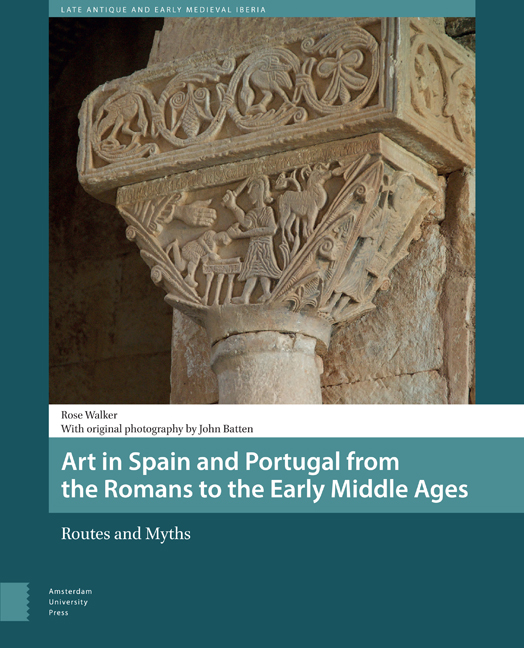
- Art in Spain and Portugal from the Romans to the Early Middle AgesRoutes and Myths, pp. 65 - 104Publisher: Amsterdam University PressPrint publication year: 2016
Accessibility standard: Unknown
Why this information is here
This section outlines the accessibility features of this content - including support for screen readers, full keyboard navigation and high-contrast display options. This may not be relevant for you.Accessibility Information
Accessibility compliance for the PDF of this chapter is currently unknown
and may be updated in the future.