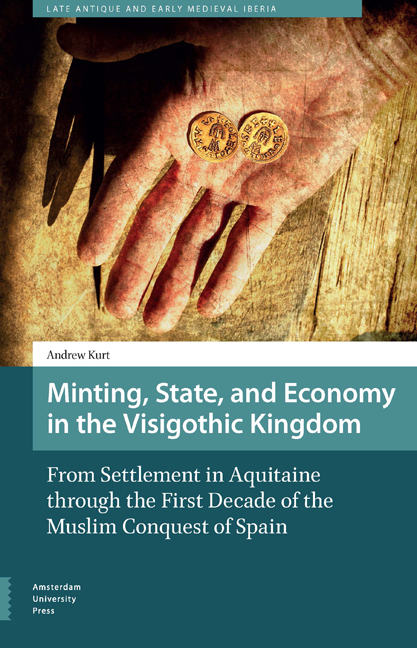
 Minting, State, and Economy in the Visigothic Kingdom
 From Settlement in Aquitaine through the First Decade of the Muslim Conquest of Spain
Book contents
- Frontmatter
- Contents
- List of figures
- Acknowledgments
- Introduction
- 1 Pre-Regal Visigothic Coinage
- 2 The King’s Coinage: The Beginning and Development of theRegal Coinage (c. 573-c. 720) 81 A The Transition to a Regal
- 3 The Activities of the Mints from c. 573- c. 720
- 4 Why Were Gold Coins Struck in the Visigothic Kingdom?
- 5 The Royal Control of Visigothic Minting
- 6 Coinage in Spain in the Aftermath of the Islamic Conquest
- 7 Visigothic Currency in the Early Medieval Economy
- Conclusion
- Appendix I
- Appendix II
- Bibliography
- About the Author
- Index
This chapter is part of a book that is no longer available to purchase from Cambridge Core
Appendix II
Book contents
- Frontmatter
- Contents
- List of figures
- Acknowledgments
- Introduction
- 1 Pre-Regal Visigothic Coinage
- 2 The King’s Coinage: The Beginning and Development of theRegal Coinage (c. 573-c. 720) 81 A The Transition to a Regal
- 3 The Activities of the Mints from c. 573- c. 720
- 4 Why Were Gold Coins Struck in the Visigothic Kingdom?
- 5 The Royal Control of Visigothic Minting
- 6 Coinage in Spain in the Aftermath of the Islamic Conquest
- 7 Visigothic Currency in the Early Medieval Economy
- Conclusion
- Appendix I
- Appendix II
- Bibliography
- About the Author
- Index
Summary
The identification of die engravers at multiple mints
An explanation should be given of the sources and of the method of analysis for the attributions of die engravers in Chapter Three, and in the photos and commentary as well as the full table that follow. I have conducted my die study over a number of years, with intermittent visits to the American Numismatic Society (ANS) in New York City. Apart from my visits, I initially relied on the photo plates in Miles's catalog and a few key sources below, to which are attached the abbreviations used in the following pages. (Plate numbers from books are given in Roman numerals, followed by Arabic numerals corresponding to the numbers of the coins on the plates.) In recent years, any detailed work on Visigothic coins in general has been greatly aided by two superb tools. Ruth Pliego's catalog (volume 2 of La moneda visidogda) provides a nearly comprehensive corpus from the time of publication in 2009 as well as a huge number of good photographs. In addition, the online digitized image bank of the ANS, called MANTIS, furnishes color images of the vast majority of the gold coins of the kingdom housed at this singular repository. At the end of this introduction to this second appendix, a concordance of old Hispanic Society of America (HSA) numbers of the ANS Visigothic regal collection and the new acquisition numbers is provided.865
Abbreviations
ANS American Numismatic Society coins studied firsthand or from photos from the collection.
Aureo Auction catalogs of Aureo, S. A., under the title of Subasta Numismática.
Bartlett Peter Bartlett, private collection, Costa Rica; photos shared by owner.
BM British Museum, coins as referenced in Pliego 2009.
Bruxelles Photos from the Cabinet des medailles of the Bibliotheque royale Albert Ier.
Chaves Rafael Chaves and María José Chaves, Acuñaciones previsigodas y visigodas en Hispania, desde Honorio a Achila II (Madrid, 1984).
Information
- Type
- Chapter
- Information
- Minting, State, and Economy in the Visigothic KingdomFrom Settlement in Aquitaine through the First Decade of the Muslim Conquest of Spain, pp. 329 - 386Publisher: Amsterdam University PressPrint publication year: 2020
Accessibility standard: Unknown
Why this information is here
This section outlines the accessibility features of this content - including support for screen readers, full keyboard navigation and high-contrast display options. This may not be relevant for you.Accessibility Information
Accessibility compliance for the PDF of this chapter is currently unknown
and may be updated in the future.