Book contents
- Frontmatter
- Contents
- Abbreviations
- List of Illustrations
- Introduction: Benedict XII, the Guardian of Orthodoxy
- 1 Jacques Fournier and Thirteenth-Century Inquisitorial Methods
- 2 Recovering a Theological Advice by Jacques Fournier
- 3 Benedict XII and the Beatific Vision
- 4 A New Seat for the Papacy: Benedict XII, Avignon, and the Comtat Venaissin
- 5 In the Footsteps of St Peter: New Light on the Half-Length Images of Benedict XII by Paolo da Siena and Boniface VIII by Arnolfo di Cambio in Old St Peter’s
- 6 Benedict XII and Italy: Restoring Orthodoxy and Consolidating Papal Sovereignty after John XXII
- 7 Benedict XII and the Outbreak of the Hundred Years’ War
- 8 Benedict XII and the Crusades
- 9 Benedict XII and the Partes Orientis
- Index of Names
- Index of Subjects
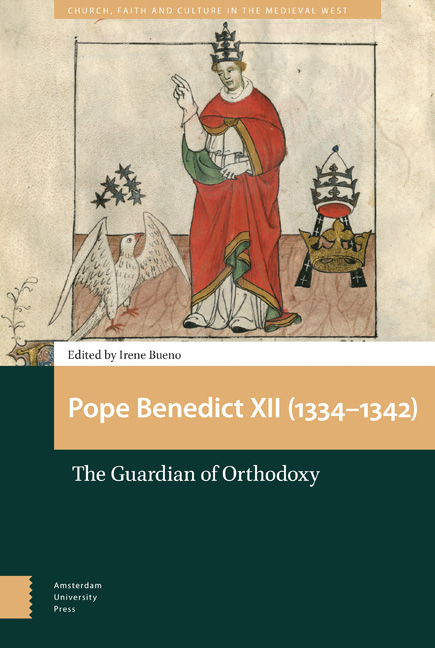
This chapter is part of a book that is no longer available to purchase from Cambridge Core
4 - A New Seat for the Papacy: Benedict XII, Avignon, and the Comtat Venaissin
Edited by
Book contents
- Frontmatter
- Contents
- Abbreviations
- List of Illustrations
- Introduction: Benedict XII, the Guardian of Orthodoxy
- 1 Jacques Fournier and Thirteenth-Century Inquisitorial Methods
- 2 Recovering a Theological Advice by Jacques Fournier
- 3 Benedict XII and the Beatific Vision
- 4 A New Seat for the Papacy: Benedict XII, Avignon, and the Comtat Venaissin
- 5 In the Footsteps of St Peter: New Light on the Half-Length Images of Benedict XII by Paolo da Siena and Boniface VIII by Arnolfo di Cambio in Old St Peter’s
- 6 Benedict XII and Italy: Restoring Orthodoxy and Consolidating Papal Sovereignty after John XXII
- 7 Benedict XII and the Outbreak of the Hundred Years’ War
- 8 Benedict XII and the Crusades
- 9 Benedict XII and the Partes Orientis
- Index of Names
- Index of Subjects
Summary
Abstract
The pontificate of Benedict XII is mostly associated with his work of theological and institutional reform and with the probity, even rigidity, with which he governed the Church. Another essential dimension of his reign deserves to be re-examined: that which consisted in officially making Avignon the new seat of the papacy, and to extend the work of his predecessor consisting of strengthening the pontifical institution by providing it with a solid local anchorage. This chapter therefore presents two inseparable dimensions of Benedict XII's policy: his work to give the Church a new administrative centre with the new palace at Avignon; and its efforts to control the Comtat Venaissin that provided the institution with the resources and calm needed to develop the Church's temporal policy on a wider scale.
Keywords: Avignon papacy, Benedict XII, Apostolic Palace, Comtat Venaissin, temporal policy of the papacy
In his role as inquisitor, Jacques Fournier has long interested historians. Yet strangely, in his later role as pope under the name Benedict XII, he has attracted far less attention than the other Avignon popes. Benedict is most often credited with settling the dispute over the Beatific Vision at its height in the early years of his pontificate, and for standing up against the most glaring forms of nepotism which were rightly associated with both Clement V (1305–1314) and John XXII (1316–1334). On the other hand, his local directives, although far from being simple anecdotes in the papacy’s institutional history, are nearly always left aside.
In this regard, Clement V is always cited concerning the choice of Avignon as a papal seat. This precarious installation, however, was only decided four years into his pontificate with the specific goal of preparing for the Council of Vienne (1311). Was this really more important for the papal institution than Benedict's decision to make the palace at Avignon officially the new seat of the papacy in 1336? In the same vein, the palace, as we know it today, is most often and primarily associated with his successor, Clement VI (1342–1352), who ensured the financing and supervision of the entire southern half of the palace where the grandest rooms and most remarkable iconographical programmes are located.
Information
- Type
- Chapter
- Information
- Pope Benedict XII (1334–1342)The Guardian of Orthodoxy, pp. 107 - 130Publisher: Amsterdam University PressPrint publication year: 2018
Accessibility standard: Unknown
Why this information is here
This section outlines the accessibility features of this content - including support for screen readers, full keyboard navigation and high-contrast display options. This may not be relevant for you.Accessibility Information
Accessibility compliance for the PDF of this chapter is currently unknown
and may be updated in the future.
- 1
- Cited by