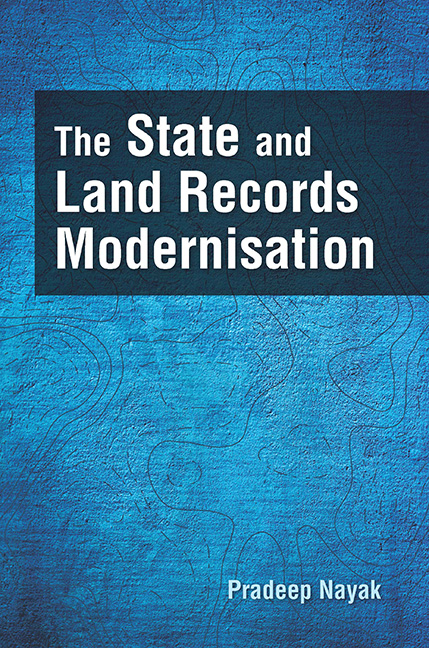
Book contents
- Frontmatter
- Dedication
- Contents
- List of Figures and Tables
- Foreword
- Preface
- List of Abbreviations
- 1 The State, ICTs and Governance: A Theoretical Exploration
- 2 E-Governance in Public Policy Discourse in India
- 3 The State and the Policy of Land Records Management
- 4 The Computerisation of Land Records Programme in Odisha
- 5 The Computerisation of Land Records Programme in Karnataka
- 6 The Computerisation of Land Records Programmes in Karnataka and Odisha: A Comparative Study
- Conclusion: Beyond Techno-Managerial Governance
- Select Bibliography
- Index
3 - The State and the Policy of Land Records Management
Published online by Cambridge University Press: 02 December 2022

Book contents
- Frontmatter
- Dedication
- Contents
- List of Figures and Tables
- Foreword
- Preface
- List of Abbreviations
- 1 The State, ICTs and Governance: A Theoretical Exploration
- 2 E-Governance in Public Policy Discourse in India
- 3 The State and the Policy of Land Records Management
- 4 The Computerisation of Land Records Programme in Odisha
- 5 The Computerisation of Land Records Programme in Karnataka
- 6 The Computerisation of Land Records Programmes in Karnataka and Odisha: A Comparative Study
- Conclusion: Beyond Techno-Managerial Governance
- Select Bibliography
- Index
Summary
The study of policy of land records management and the role of the Indian state cannot be completely understood without taking into account the history of the land records system along with its bewildering regional diversities, and its management particularly since the British period. British rule laid the foundation of property rights on land and took elaborate measures for survey and settlement.
The land records system: a historical perspective
The land records and revenue system and its tenurial relations have been intricately related to its social conditions since long, and to a large extent sustained by the agrarian nature of India's society and economy. For centuries, there have been layer upon layer of landholders and revenue collections interrelated among themselves. ‘… what we see is a spectral view of socially structured land control relationships with gradations…’ on the one extreme lord over land and labour and on the other end labourer on land. Between the two extreme positions there exist innumerable strata of lesser lords and larger labourers.
The land tenure systems and land relations in India is very complex due to the existence of a ‘veritable jungle of overlapping terminologies.’ Dharma Kumar, a historian, writes that the period prior to British occupation and rule was marked by chaos as the Mughal reign was in decline. The Britishers were ‘confused about the rights they had to confirm and administer’ as very scanty information on land records was available to them. They had to choose between various claimants to rights in a tenure system largely unknown to them, and used in a multiplicity of local languages, as well as Persian/Arabic terms coined by Muslim rulers. The British added further confusion ‘in their natural tendency to look everything from an English Law or Lord-of-themanor point of view.’ Therefore the linguistic overlapping of land holdings and tenures has been prone to errors and misinterpretations.
Despite the variegated nature of terminologies one could observe that all kinds of holdings and rights were intricately linked to definite socio-ceremonial, communal, economic and political roles. Neither hereditary ownerships nor customary authority constituted a legal claim to ownership of the land—this complicates the process of defining and classifying the many interrelated positions of social status and landed interests.
Information
- Type
- Chapter
- Information
- The State and Land Records Modernisation , pp. 75 - 129Publisher: Foundation BooksPrint publication year: 2015
Accessibility standard: Unknown
Why this information is here
This section outlines the accessibility features of this content - including support for screen readers, full keyboard navigation and high-contrast display options. This may not be relevant for you.Accessibility Information
Accessibility compliance for the PDF of this chapter is currently unknown
and may be updated in the future.