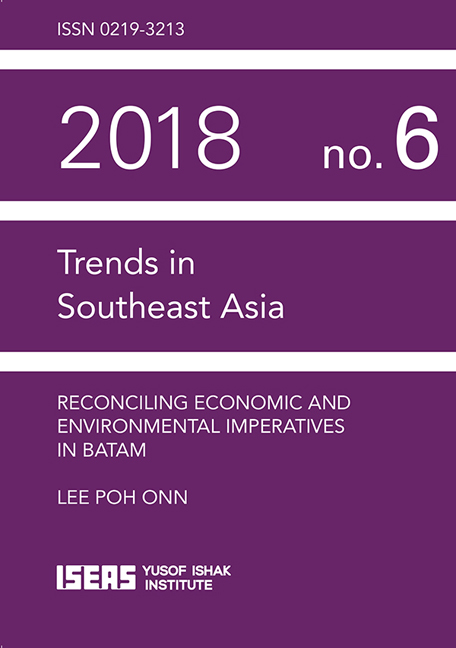
Reconciling Economic and Environmental Imperatives in Batam

-
Select format
-
- Publisher:
- ISEAS–Yusof Ishak Institute
- Publication date:
- 12 February 2019
- 06 March 2018
- ISBN:
- 9789814818346
- 9789814818339
- Dimensions:
- Weight & Pages:
- Dimensions:
- Weight & Pages:
- Subjects:
- Economics, Economics: General Interest
- Series:
- Trends in Southeast Asia
You may already have access via personal or institutional login- Subjects:
- Economics, Economics: General Interest
- Series:
- Trends in Southeast Asia
Show more authors 
You may already have access via personal or institutional login
Book description
Batam's economic transformation has been accompanied by a marked degradation of its natural environment. Enforcement to protect the environment has often been inadequate on many fronts, exacerbated by population increases. Though regulations exist for the provision of public amenities like wastewater and sewerage treatment, existing facilities are run-down and ill-equipped to cope with the present demands. The capacity of reservoirs to meet the present demand for water is also strained because of the large population base, with illegal intrusion and squatters further threatening supplies. Economic and environmental imperatives can be reconciled if more emphasis and resources are put into enforcing regulations and protecting the environment.
Metrics
Full text views
Full text views helpTotal number of HTML views: 0
Total number of PDF views: 0 *
 Loading metrics...
* Views captured on Cambridge Core between #date#. This data will be updated every 24 hours.
Usage data cannot currently be displayed.
Accessibility standard: Unknown
Why this information is here
This section outlines the accessibility features of this content - including support for screen readers, full keyboard navigation and high-contrast display options. This may not be relevant for you.
Accessibility Information
Accessibility compliance for the PDF of this book is currently unknown and may be updated in the future.