Book contents
- Front Matter
- Contents
- Plates
- Figures
- Tables
- Acknowledgments
- Chapter 1 Introduction
- Part I THE REMEMBERED PRESENT
- Part II THE DOCUMENTED PAST
- Part III EMERGENT SOCIAL AND POLITICAL PATTERNS
- Appendix I Pronouncing Locorotondese dialect
- Appendix II Glossary of Italian and dialect terms
- Notes
- Bibliography
- Index
- Plates Section
Chapter 1 - Introduction
Published online by Cambridge University Press: 22 September 2009

Book contents
- Front Matter
- Contents
- Plates
- Figures
- Tables
- Acknowledgments
- Chapter 1 Introduction
- Part I THE REMEMBERED PRESENT
- Part II THE DOCUMENTED PAST
- Part III EMERGENT SOCIAL AND POLITICAL PATTERNS
- Appendix I Pronouncing Locorotondese dialect
- Appendix II Glossary of Italian and dialect terms
- Notes
- Bibliography
- Index
- Plates Section
Summary
BACKGROUND
In Locorotondo, in the heel of Southern Italy, the rural folk repeat a proverb: “If you want to eat bread, stay far from the church bells.” This book is about the meaning of that proverb. It explores the history, causes, and sociocultural ramifications of the unusual settlement pattern found in Locorotondo and in other towns located in a zone of Apulia in Southern Italy known as the Murgia dei Trulli (the Plateau of the Trulli). Trulli are peasant dwellings characterized by cone-shaped domes surmounted by whitewashed finial ornaments, and are found only in this zone of Italy. Here a high proportion of residence in the countryside accompanies a moderate degree of peasant prosperity in what one turn-of-the-century geographer called “an oasis of small property in a zone of large estates” (Maranelli, 1946). The settlement pattern of Locorotondo originated at least as far back as the early eighteenth century, consolidated during the nineteenth, and has endured through the upheavals of the twentieth into the present. A little over 50 percent of the town's population continues to live in the countryside, and relative prosperity, based upon the building trades adopted by the sons of generations of peasant small proprietors, persists in the countryside.
After a day's visit in 1974 during a journey home from the Island of Pantelleria, my other field site, and after much library research, I chose the Murgia dei Trulli for concentrated study.
Information
- Type
- Chapter
- Information
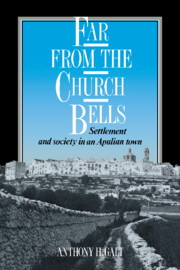
- Far from the Church BellsSettlement and Society in an Apulian Town, pp. 1 - 14Publisher: Cambridge University PressPrint publication year: 1991
Accessibility standard: Unknown
Why this information is here
This section outlines the accessibility features of this content - including support for screen readers, full keyboard navigation and high-contrast display options. This may not be relevant for you.Accessibility Information
Accessibility compliance for the PDF of this chapter is currently unknown
and may be updated in the future.
- 1
- Cited by