Book contents
- Frontmatter
- Contents
- Illustrations
- Acknowledgements
- Introduction
- 1 Convicts and Early Settlement
- 2 Waves of Migration
- 3 A Place in Australian Society
- 4 The Watershed Years
- 5 Diverse Voices
- 6 Israel and Zionism
- 7 Transformation or Disappearance?
- 8 Jewish Women
- 9 The Broader Community
- 10 Recent Immigrants
- Conclusion
- Appendix 1 Synagogues
- Appendix 2 Parliamentarians
- Appendix 3 Hostels, 1945–1960
- Notes
- Bibliography
- Index
4 - The Watershed Years
Published online by Cambridge University Press: 22 September 2009

Book contents
- Frontmatter
- Contents
- Illustrations
- Acknowledgements
- Introduction
- 1 Convicts and Early Settlement
- 2 Waves of Migration
- 3 A Place in Australian Society
- 4 The Watershed Years
- 5 Diverse Voices
- 6 Israel and Zionism
- 7 Transformation or Disappearance?
- 8 Jewish Women
- 9 The Broader Community
- 10 Recent Immigrants
- Conclusion
- Appendix 1 Synagogues
- Appendix 2 Parliamentarians
- Appendix 3 Hostels, 1945–1960
- Notes
- Bibliography
- Index
Summary
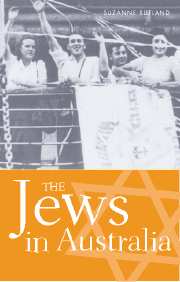
The watershed years for Australian Jewish history occurred with the refugee flight from Nazism in the late 1930s and the survivor emigration in the aftermath of World War II. There had been some Jewish immigration from Poland during the 1920s, but the population from 1921 to 1933 remained static. In 1933, there were only 23 000 Jews in Australia. Between 1938 and 1961, the community almost trebled to 61 000, with around 9000 refugees arriving between 1938 and 1940, 17 000 survivors arriving between 1946 and 1954 from Europe and Shanghai, and a further 10 000 until 1961, including those who escaped at the time of the 1956 Hungarian revolution. These three waves completely changed the nature of the Australian Jewish community, but Jews continued to constitute only 0.5 per cent of the overall population because of the hostility that was expressed towards Jewish immigration.
Anti-refugee hysteria
Proposals to admit Jewish refugees met with a hostile reception. Known as ‘anti-refo’ feeling, this manifested itself in the late 1930s and continued after 1945 in general newspapers, in statements by some members of parliament and in resolutions passed by pressure groups such as the forerunner of the Returned Services League (RSL) and the Australian Natives' Association. Extreme feelings were also expressed in daubing and damage to property, particularly in areas of Jewish concentrations in Melbourne and Sydney.
These negative reactions were due to Australian isolationism.
Information
- Type
- Chapter
- Information
- The Jews in Australia , pp. 51 - 65Publisher: Cambridge University PressPrint publication year: 2005
Accessibility standard: Unknown
Why this information is here
This section outlines the accessibility features of this content - including support for screen readers, full keyboard navigation and high-contrast display options. This may not be relevant for you.Accessibility Information
Accessibility compliance for the PDF of this chapter is currently unknown
and may be updated in the future.