Book contents
- Frontmatter
- Contents
- Acknowledgments
- Introduction
- Chapter 1 “Moralize two meanings” in one play: contrariety on the Tudor stage
- Chapter 2 Performance, game, and representation in Richard III
- Chapter 3 Mingling vice and “worthiness” in King John
- Chapter 4 Clowning: agencies between voice and pen
- Chapter 5 Clowning at the frontiers of representation
- Chapter 6 Cross-dressing and performance in disguise
- Chapter 7 Personation and playing: “secretly open” role-playing
- Chapter 8 Character/actor: the deep matrix
- Chapter 9 Character: depth, dialogue, page
- Chapter 10 King Lear: representations on stage and page
- Notes
- Index
- References
Chapter 1 - “Moralize two meanings” in one play: contrariety on the Tudor stage
Published online by Cambridge University Press: 22 September 2009

Book contents
- Frontmatter
- Contents
- Acknowledgments
- Introduction
- Chapter 1 “Moralize two meanings” in one play: contrariety on the Tudor stage
- Chapter 2 Performance, game, and representation in Richard III
- Chapter 3 Mingling vice and “worthiness” in King John
- Chapter 4 Clowning: agencies between voice and pen
- Chapter 5 Clowning at the frontiers of representation
- Chapter 6 Cross-dressing and performance in disguise
- Chapter 7 Personation and playing: “secretly open” role-playing
- Chapter 8 Character/actor: the deep matrix
- Chapter 9 Character: depth, dialogue, page
- Chapter 10 King Lear: representations on stage and page
- Notes
- Index
- References
Summary
The “memory” that held “a seat / In this distracted globe” (Hamlet, 1.5.96–7) clearly included the recollection of the Morality stage. For one thing, Shakespeare's plays remembered the morality tradition through the latter's most theatrical figuration: the “old Vice” (Twelfth Night, 4.2.124). As highly performative equivocator, the Vice drew on two divergent modes of authorizing the uses of dramatic language and theatrical space. Central to this divergence in discursive practice was a formal incongruity between the serious and the comic which, though deeply embedded in the earlier history of medieval drama, continued to provide a semantic underside to the morality context. Combining sinfulness and sport, the Vice – a strange gallimaufry of types and roles – appealed to a divided authority in signification. Through the performative thrust of his own lop-sided inclination, this farcical agent pointedly upset symmetries in the allegorical order of things. Disturbing the homiletic bifurcations between good and evil, the Vice championed all sorts of confusions between serious sinfulness and comic theatricality.
In English Renaissance drama the Vice is perhaps best remembered in the traces he left, via Richard Tarlton and Will Kemp, in the Shakespearean clown. More broadly, his legacy helped Renaissance dramatists straddle the divide between the comic and the tragic, and gave them a powerful model for, among other “playwright” figures in dramatic texts, the darkly humorous plotters of revenge tragedy.
Information
- Type
- Chapter
- Information
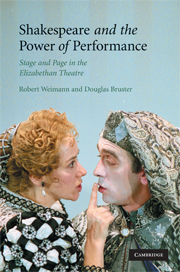
- Shakespeare and the Power of PerformanceStage and Page in the Elizabethan Theatre, pp. 26 - 41Publisher: Cambridge University PressPrint publication year: 2008
References
, “The Improvising Vice in Renaissance England,” in , ed., Improvisation in the Arts of the Middle Ages and Renaissance (Kalamazoo: Western Michigan University Press, 2003), 273–85Google Scholar
, “Dangerous Sport: The Audience's Engagement with Vice in the Moral Interlude,” Renaissance Drama 6 (1973), 45–64CrossRefGoogle Scholar
, Engagement with Knavery: Point of View in “Richard III,” “The Jew of Malta,” “Volpone,” and “The Revenger's Tragedy” (Durham: Duke University Press, 1986)Google Scholar
, Marlowe and the Popular Tradition: Innovation in the English Drama before 1595 (Manchester: Manchester University Press, 2002), 102Google Scholar
, Quoting Shakespeare: Form and Culture in Early Modern Drama (Lincoln: University of Nebraska Press, 2000)Google Scholar
, Languages of the Stage: Essays in the Semiology of the Theatre (New York: Performing Arts Journal Publications, 1982), 45Google Scholar
's phrase, an alienating “analysis” within a “progressive and educative narrative” (Bertolt Brecht: Dialectics, Poetry, Politics [London: Croom Helm, 1988], 51–2)Google Scholar
, Mighty Opposites: Shakespeare and Renaissance Contrariety (Berkeley: University of California Press, 1979)Google Scholar
, Directions for Speech and Style, ed. (Princeton: Princeton University Press, 1935), 21Google Scholar
, Paradoxia Epidemica: The Renaissance Tradition of Paradox (Princeton: Princeton University Press, 1966)Google Scholar
, “Lying Like Truth: Riddle, Representation, and Treason in Renaissance England,” ELH 47 (1980), 32–47CrossRefGoogle Scholar
, Habits of Thought in the English Renaissance: Religion, Politics, and the Dominant Culture (Berkeley: University of California Press, 1990)Google Scholar
, “The Defence of Contraries: Skeptical Paradox in A King and No King,” SEL 21 (1981), 319–32Google Scholar
, “Representation and Performance: The Uses of Authority in Shakespeare's Theater,” PMLA 107 (May 1992), 497–510CrossRefGoogle Scholar
, The Defence of Poesy, in Sir Philip Sidney: Selected Prose and Poetry, 2nd edn, ed. (Madison: University of Wisconsin Press, 1983), 150Google Scholar
, The Dialogic Imagination: Four Essays, ed. , trans. and (Austin: University of Texas Press, 1981)Google Scholar
, Self-Speaking in Medieval and Early Modern English Drama: Subjectivity, Discourse and the Stage (New York: St. Martin's Press, 1997), 46CrossRefGoogle Scholar
, Shakespeare and the Popular Tradition in the Theater: Studies in the Social Dimension of Dramatic Form and Function (Baltimore: Johns Hopkins University Press, 1978), 112–53Google Scholar
, Allegory: The Theory of a Symbolic Mode (Ithaca: Cornell University Press, 1970), 332Google Scholar
, Preface to Greenblatt, ed., Allegory and Representation: Selected Papers from the English Institute, 1979–80 (Baltimore: Johns Hopkins University Press, 1981), viiiGoogle Scholar
, From “Mankind” to Marlowe: Growth of Structure in the Popular Drama of Tudor England (Cambridge, MA: Harvard University Press, 1962), 80–3CrossRefGoogle Scholar
A Select Collection of Old English Plays (Dodsley), ed. , 4th edn (repr. New York: Benjamin Blom, 1964), 3:268Google Scholar
's phrase, an “offene Spielsphäre.” See Diller's magisterial Redeformen des englischen Misterienspiels (Munich: Fink, 1973), 148–216, translated into English as The Middle English Mystery Play: A Study in Dramatic Speech and Form, trans. Frances Wessels (Cambridge and New York: Cambridge University Press, 1992)Google Scholar
, Author's Pen and Actor's Voice (Cambridge: Cambridge University Press, 2000)CrossRefGoogle Scholar
Accessibility standard: Unknown
Why this information is here
This section outlines the accessibility features of this content - including support for screen readers, full keyboard navigation and high-contrast display options. This may not be relevant for you.Accessibility Information
Accessibility compliance for the PDF of this chapter is currently unknown
and may be updated in the future.