Book contents
- Frontmatter
- Contents
- Preface
- A note on the musical examples and the edition
- Chapter 1 Introduction: Adémar de Chabannes and Saint Martial de Limoges
- Chapter 2 Music scribe
- Chapter 3 Compiler
- Chapter 4 Editor
- Chapter 5 Composer
- Chapter 6 Singer
- Chapter 7 Conclusion: The success of the apostolic campaign
- Appendix A Manuscripts with Adémar's music hand
- Appendix B Adémar's original compositions
- Bibliography
- Index of chants
- Index of manuscripts
- General index
Chapter 3 - Compiler
Published online by Cambridge University Press: 22 September 2009

Book contents
- Frontmatter
- Contents
- Preface
- A note on the musical examples and the edition
- Chapter 1 Introduction: Adémar de Chabannes and Saint Martial de Limoges
- Chapter 2 Music scribe
- Chapter 3 Compiler
- Chapter 4 Editor
- Chapter 5 Composer
- Chapter 6 Singer
- Chapter 7 Conclusion: The success of the apostolic campaign
- Appendix A Manuscripts with Adémar's music hand
- Appendix B Adémar's original compositions
- Bibliography
- Index of chants
- Index of manuscripts
- General index
Summary
The creators of new liturgies throughout the Middle Ages frequently employed borrowed and adapted items from existing liturgies. Those less talented or ambitious in the composition of entirely new works could still express themselves in this forum and perform useful service for their institutions. Perhaps more important, the reuse of familiar pieces forged meaningful links between the new liturgies and existing practice, creating associations between saints, for example, whose feasts shared pieces, or the several Marian feasts throughout the year. Monks at Saint Martial in the generations before Adémar produced a rich liturgical tradition with precisely these means, most outstandingly in the earliest documented liturgy for their patron saint, as I discuss below. Adémar, too, employed the method; in every case, he capitalized on the matrix of associations the process afforded to make very particular statements within the new liturgy he was creating.
His application of this technique, however, moves far beyond the borrowing and adaptation of existing pieces. In creating as full a record as possible of the new apostolic liturgy for the Feast of Saint Martial, Adémar provided significantly greater detail about liturgical practice, particularly in the Divine Office, than his predecessors. He seems to have had several purposes in mind for this level of detail, chief among which was the creation of a permanent and authoritative written record, as discussed in Chapter 2 above. Such a monument, Adémar believed, would help to give credence to the new liturgy for Martial.
Information
- Type
- Chapter
- Information
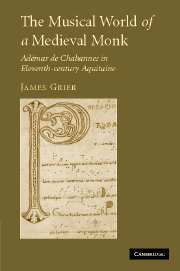
- The Musical World of a Medieval MonkAdémar de Chabannes in Eleventh-century Aquitaine, pp. 97 - 158Publisher: Cambridge University PressPrint publication year: 2006
Accessibility standard: Unknown
Why this information is here
This section outlines the accessibility features of this content - including support for screen readers, full keyboard navigation and high-contrast display options. This may not be relevant for you.Accessibility Information
Accessibility compliance for the PDF of this chapter is currently unknown
and may be updated in the future.