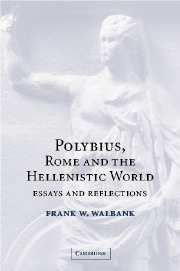
Book contents
- Frontmatter
- Contents
- Preface
- Acknowledgements
- List of abbreviations
- 1 Polybian studies, c. 1975–2000
- HISTORICAL AND GEOGRAPHICAL PAPERS
- 2 The geography of Polybius
- 3 Egypt in Polybius
- 4 The surrender of the Egyptian rebels in the Nile delta (Polyb. xxii.17.1–7)
- 5 Two Hellenistic processions: a matter of self-definition
- 6 Polybius and Macedonia
- 7 Sea-power and the Antigonids
- 8 H TΩN OΛΩN EΛΠΙΣ and the Antigonids
- 9 Hellenes and Achaeans: ‘Greek nationality’ revisited
- 10 The Achaean assemblies
- POLYBIUS AS A HISTORIAN
- POLYBIUS ON ROME
- TRANSMISSION OF POLYBIUS
- Bibliography
- Indexes
5 - Two Hellenistic processions: a matter of self-definition
Published online by Cambridge University Press: 22 September 2009

Book contents
- Frontmatter
- Contents
- Preface
- Acknowledgements
- List of abbreviations
- 1 Polybian studies, c. 1975–2000
- HISTORICAL AND GEOGRAPHICAL PAPERS
- 2 The geography of Polybius
- 3 Egypt in Polybius
- 4 The surrender of the Egyptian rebels in the Nile delta (Polyb. xxii.17.1–7)
- 5 Two Hellenistic processions: a matter of self-definition
- 6 Polybius and Macedonia
- 7 Sea-power and the Antigonids
- 8 H TΩN OΛΩN EΛΠΙΣ and the Antigonids
- 9 Hellenes and Achaeans: ‘Greek nationality’ revisited
- 10 The Achaean assemblies
- POLYBIUS AS A HISTORIAN
- POLYBIUS ON ROME
- TRANSMISSION OF POLYBIUS
- Bibliography
- Indexes
Summary
Les folies des spectacles était une maladie de leurs très grandes villes, Rome, Alexandrie ou Antioche.
P. Veyne, Le Pain et le cirque, 696A recent trend in Hellenistic studies has been to emphasise the importance of the indigenous peoples within the successor kingdoms to Alexander at the expense of the Greco-Macedonian element. Within limits this is to be welcomed, for there can be no doubt that in the past, for a combination of reasons, native influence on the life and culture of those states has been underestimated. With the exception of Macedonia itself, all these Hellenistic kingdoms contained ancient, alien structures, which the new Macedonian rulers in Persia, Babylonia and Egypt could not afford to ignore. Relations with their more numerous non-Greek subjects were always a central problem and one which changed over the years. In Egypt, for instance, Egyptian influence in the army and administration, as well as in everyday life, grew steadily from the end of the third century onwards. How indeed these Macedonian kings – and their subject populations – saw themselves in this multicultural world must form a matter of central interest.
Despite this, however, it remains true that the cultural roots of the rulers and ruling castes, at any rate within the more important of the successor states, lay in a Hellenised Macedonia and that many of their institutions derived from Macedonia and the Greek polis. Ptolemy, Seleucus, Cassander, Antigonus, Lysimachus were all Macedonians.
Information
- Type
- Chapter
- Information
- Polybius, Rome and the Hellenistic WorldEssays and Reflections, pp. 79 - 90Publisher: Cambridge University PressPrint publication year: 2002
Accessibility standard: Unknown
Why this information is here
This section outlines the accessibility features of this content - including support for screen readers, full keyboard navigation and high-contrast display options. This may not be relevant for you.Accessibility Information
Accessibility compliance for the PDF of this chapter is currently unknown
and may be updated in the future.
- 1
- Cited by