Book contents
- Frontmatter
- Contents
- Notes on contributors
- Preface
- Introduction
- 1 Apophaticism, idolatry and the claims of reason
- 2 The quest for a place which is ‘not-a-place’: the hiddenness of God and the presence of God
- 3 The gift of the Name: Moses and the burning bush
- 4 Aquinas on the Trinity
- 5 Vere tu es Deus absconditus: the hidden God in Luther and some mystics
- 6 The deflections of desire: negative theology in trinitarian disclosure
- 7 The formation of mind: Trinity and understanding in Newman
- 8 ‘In the daylight forever?’: language and silence
- 9 Apophasis and the Shoah: where was Jesus Christ at Auschwitz?
- 10 Soundings: towards a theological poetics of silence
- Select bibliography
- Index
Preface
Published online by Cambridge University Press: 22 September 2009

Book contents
- Frontmatter
- Contents
- Notes on contributors
- Preface
- Introduction
- 1 Apophaticism, idolatry and the claims of reason
- 2 The quest for a place which is ‘not-a-place’: the hiddenness of God and the presence of God
- 3 The gift of the Name: Moses and the burning bush
- 4 Aquinas on the Trinity
- 5 Vere tu es Deus absconditus: the hidden God in Luther and some mystics
- 6 The deflections of desire: negative theology in trinitarian disclosure
- 7 The formation of mind: Trinity and understanding in Newman
- 8 ‘In the daylight forever?’: language and silence
- 9 Apophasis and the Shoah: where was Jesus Christ at Auschwitz?
- 10 Soundings: towards a theological poetics of silence
- Select bibliography
- Index
Summary
This book originated in a colloquium that was held at the University of Birmingham in Spring 1999. The contributors represented different fields of interest in Christian theology, but a common theme in their work was an engagement with what is often termed ‘spirituality’, that is to say with Christianity as an existential and dialectical religion. There was a further consensus that the dimension of negativity, or apophasis, which is most often associated with the canon of Christian mystical texts, belongs also to mainstream Christianity and can be found in theological works not normally considered to be of a ‘mystical’ kind. In the resulting volume, each contributor is exploring in his or her own way the extent to which the concept of the apophatic illumines some of the deepest doctrinal structures of Christian faith, and of Christian self-understanding in terms both of its historical and contemporary situatedness. It is hoped that the resulting conversations between contributors will reach out beyond the ranks of those who ordinarily study the ‘mystical’ and will creatively engage those for whom such concerns may appear limited or marginal.
The editors wish to express their thanks to the Department of Theology at the University of Birmingham for offering financial support for the original colloquium, as they do to Kevin Taylor and the staff of Cambridge University Press for their kind and efficient collaboration in the production of this volume.
Information
- Type
- Chapter
- Information
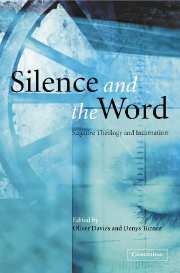
- Silence and the WordNegative Theology and Incarnation, pp. xi - xiiPublisher: Cambridge University PressPrint publication year: 2002
Accessibility standard: Unknown
Why this information is here
This section outlines the accessibility features of this content - including support for screen readers, full keyboard navigation and high-contrast display options. This may not be relevant for you.Accessibility Information
Accessibility compliance for the PDF of this chapter is currently unknown
and may be updated in the future.