Book contents
- Frontmatter
- Contents
- List of figures
- List of tables
- Notes on the contributors
- 1 Capital punishment: improve it or remove it?
- 2 International law and the death penalty: reflecting or promoting change?
- 3 Doctors and the death penalty: ethics and a cruel punishment
- 4 Replacing the death penalty: the vexed issue of alternative sanctions
- 5 Religion and the death penalty in the United States: past and present
- 6 On botched executions
- 7 Death as a penalty in the Shari'ā
- 8 Abolishing the death penalty in the United States: an analysis of institutional obstacles and future prospects
- 9 Capital punishment in the United States: moratorium efforts and other key developments
- 10 The experience of Lithuania's journey to abolition
- 11 The death penalty in South Korea and Japan: ‘Asian values’ and the debate about capital punishment?
- 12 Georgia, former republic of the USSR: managing abolition
- 13 Capital punishment in the Commonwealth Caribbean: colonial inheritance, colonial remedy?
- 14 Public opinion and the death penalty
- 15 Capital punishment: meeting the needs of the families of the homicide victim and the condemned
- Index
5 - Religion and the death penalty in the United States: past and present
Published online by Cambridge University Press: 22 September 2009

Book contents
- Frontmatter
- Contents
- List of figures
- List of tables
- Notes on the contributors
- 1 Capital punishment: improve it or remove it?
- 2 International law and the death penalty: reflecting or promoting change?
- 3 Doctors and the death penalty: ethics and a cruel punishment
- 4 Replacing the death penalty: the vexed issue of alternative sanctions
- 5 Religion and the death penalty in the United States: past and present
- 6 On botched executions
- 7 Death as a penalty in the Shari'ā
- 8 Abolishing the death penalty in the United States: an analysis of institutional obstacles and future prospects
- 9 Capital punishment in the United States: moratorium efforts and other key developments
- 10 The experience of Lithuania's journey to abolition
- 11 The death penalty in South Korea and Japan: ‘Asian values’ and the debate about capital punishment?
- 12 Georgia, former republic of the USSR: managing abolition
- 13 Capital punishment in the Commonwealth Caribbean: colonial inheritance, colonial remedy?
- 14 Public opinion and the death penalty
- 15 Capital punishment: meeting the needs of the families of the homicide victim and the condemned
- Index
Summary
Organised movements of protest against capital punishment have been a regular feature in the history of the United States. As the society itself has changed, cycles of abolitionism have had different characteristics. One such characteristic is the role which religion played in each era. The purpose of this chapter is to review some of this strange history in the hope of seeing whether it may hold lessons for promoting a better future, an America that might finally ‘catch up with itself’.
Early efforts at abolition
In the ‘First Abolitionist Era’, running from the 1830s through to the 1850s, a few states, such as Michigan (1846), Rhode Island (1852) and Wisconsin (1853) succeeded in abolishing capital punishment, but a more widespread legacy of that age was the elimination of public hangings. These were abandoned in at least fifteen states during this period. The removal of executions from public squares to prison yards was a strangely ambiguous social move, since it seemed to hit at the very heart of the alleged deterrent purpose of capital punishment by veiling its reality from the general public. In any event, it certainly changed the setting and tone of executions, which were no longer the popular spectacles of old, and this may have played an ironic role in actually delaying full abolition, ‘the final resolution of the issue’.
From a religious perspective, this alteration in format automatically diminished the role of the clergy by depriving them of a large public audience.
Information
- Type
- Chapter
- Information
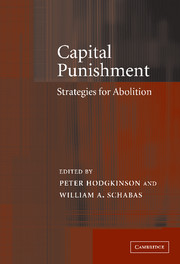
- Capital PunishmentStrategies for Abolition, pp. 116 - 142Publisher: Cambridge University PressPrint publication year: 2004
Accessibility standard: Unknown
Why this information is here
This section outlines the accessibility features of this content - including support for screen readers, full keyboard navigation and high-contrast display options. This may not be relevant for you.Accessibility Information
Accessibility compliance for the PDF of this chapter is currently unknown
and may be updated in the future.
- 1
- Cited by