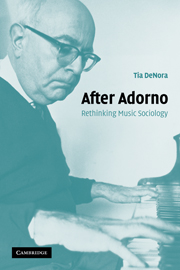
Book contents
- Frontmatter
- Contents
- List of figures
- List of music examples
- Preface: a two part invention
- Acknowledgements
- A note on background reading
- 1 Adorno, ‘defended against his devotees’?
- 2 New methods and classic concerns
- 3 Music as cognition
- 4 How does music ‘channel’ emotion?
- 5 Music and ‘control’
- 6 After Adorno: rethinking music sociology
- Bibliography
- Index
2 - New methods and classic concerns
Published online by Cambridge University Press: 22 September 2009

Book contents
- Frontmatter
- Contents
- List of figures
- List of music examples
- Preface: a two part invention
- Acknowledgements
- A note on background reading
- 1 Adorno, ‘defended against his devotees’?
- 2 New methods and classic concerns
- 3 Music as cognition
- 4 How does music ‘channel’ emotion?
- 5 Music and ‘control’
- 6 After Adorno: rethinking music sociology
- Bibliography
- Index
Summary
Music sociology, the ‘new’ musicology, and Adorno
While Adorno has been all but forgotten by music sociologists (though not by social and cultural theorists), his work is alive and well in musicology. Indeed, the vicissitudes of Adorno's reputation within music scholarship highlight just how dramatically that field has changed since the 1970s, when Rose Rosengard Subotnik's uncanny sensitivity to his thought was virtually the only torch to be carried for Adorno there. Subotnik's work has since been vindicated and interest in Adorno's work burgeons. This interest can, I suggest, be read as part of a wider paradigm shift within musicology.
Today – or so it seems looking in from the outside – most musicologists would probably agree with Donald Randel's observation (1992) that musicology's more traditional ‘toolbox’ had been designed for the work of constructing and maintaining a canon of acceptable topics – works, great works, great composers. In roughly the past fifteen years, and in response to developments in other disciplines such as literary theory, philosophy, history, anthropology, and, to a much smaller extent, sociology, the field of musicology has been thoroughly revised. Today the ‘new’ musicologists (a term dating to at least to the middle 1980s) have called into question the separation of historical issues (biography and the social contexts of music-making) and musical form. They have focused instead on music's role as a social medium. This move, once controversial, has now, it seems fair to say, been institutionalised within the discipline.
Information
- Type
- Chapter
- Information
- After AdornoRethinking Music Sociology, pp. 35 - 58Publisher: Cambridge University PressPrint publication year: 2003
Accessibility standard: Unknown
Why this information is here
This section outlines the accessibility features of this content - including support for screen readers, full keyboard navigation and high-contrast display options. This may not be relevant for you.Accessibility Information
Accessibility compliance for the PDF of this chapter is currently unknown
and may be updated in the future.