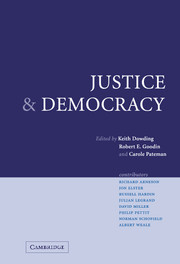
Book contents
- Frontmatter
- Contents
- List of figures
- List of contributors
- 1 Introduction: between justice and democracy
- 2 Are democratic and just institutions the same?
- 3 Democracy is not intrinsically just
- 4 ‘The probability of a fit choice’: American political history and voting theory
- 5 Contractarian theory, deliberative democracy and general agreement
- 6 Democracy, justice and impartiality
- 7 Mimicking impartiality
- 8 Justice, democracy and public goods
- 9 The common good
- 10 Individual choice and social exclusion
- 11 Subnational groups and globalization
- References
- Brian Barry's publications
- Index
9 - The common good
Published online by Cambridge University Press: 22 September 2009

Book contents
- Frontmatter
- Contents
- List of figures
- List of contributors
- 1 Introduction: between justice and democracy
- 2 Are democratic and just institutions the same?
- 3 Democracy is not intrinsically just
- 4 ‘The probability of a fit choice’: American political history and voting theory
- 5 Contractarian theory, deliberative democracy and general agreement
- 6 Democracy, justice and impartiality
- 7 Mimicking impartiality
- 8 Justice, democracy and public goods
- 9 The common good
- 10 Individual choice and social exclusion
- 11 Subnational groups and globalization
- References
- Brian Barry's publications
- Index
Summary
The republican tradition in political theory has long insisted on the centrality of the notion of the common good, arguing that if the state is forced to track the common good then it won't dominate its citizens. Not only can it serve the republican ideal of promoting freedom as non-domination of members of the public against private masters: the state will not itself have the cast of a public master; it will interfere with people in the course of tracking the common good but the interference will not be of the dominating variety (Sellers 1995; Pettit 1997; Skinner 1998; Viroli 2002).
I have two aims in this chapter. One is to look at what ‘the common good’ has got to mean if this republican axiom is going to be plausible, and the other is to consider how the common good might be identified and empowered in political life, as republican theory suggests that it ought to be. In pursuing these aims – though they relate to my projects rather than his – I will draw freely on Brian Barry's early but still unsurpassed discussion of common or public interests (Barry 1965).
The chapter is in three sections. The first section argues that ‘the common good’ cannot plausibly refer to people's common net interests but only to the common interests that people have as members of the public.
Information
- Type
- Chapter
- Information
- Justice and DemocracyEssays for Brian Barry, pp. 150 - 169Publisher: Cambridge University PressPrint publication year: 2004
Accessibility standard: Unknown
Why this information is here
This section outlines the accessibility features of this content - including support for screen readers, full keyboard navigation and high-contrast display options. This may not be relevant for you.Accessibility Information
Accessibility compliance for the PDF of this chapter is currently unknown
and may be updated in the future.
- 43
- Cited by