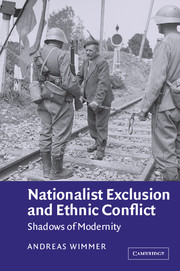
1 - Shadows of modernity
Published online by Cambridge University Press: 22 September 2009

Summary
Three different points of view dominate the current debate on ethnicity and nationalism (cf. Smith 1998). For some, nations and ethnic groups are genuinely modern phenomena, the by-product of the rise of the territorial state or of industrial development. Others regard ethnic and nationalist politics as transitory phenomena, the birth pains of the modern age that will be forgotten as soon as democracy and civil society have grown to maturity. For still others, ethnicity represents the perennial basis of human history, limiting the range of nationalist inventions and imaginations in modern times.
This book goes one step beyond this debate by radicalising the modernist position. It will be shown that nationalist and ethnic politics are not just a by-product of modern state formation or of industrialisation; rather, modernity itself rests on a basis of ethnic and nationalist principles.
Modern societies unfolded within the confines of the nation-state and strengthened them with every step of development. On the one side, the modern principles of democracy, citizenship and popular sovereignty allowed for the inclusion of large sections of the population previously confined to the status of subjects and subordinates. On the other, shadowy side, however, new forms of exclusion based on ethnic or national criteria developed, largely unacknowledged by the grand theories of modernity as a universalistic and egalitarian model of society. Belonging to a specific national or ethnic group determines access to the rights and services the modern state is supposed to guarantee.
Information
- Type
- Chapter
- Information
- Nationalist Exclusion and Ethnic ConflictShadows of Modernity, pp. 1 - 16Publisher: Cambridge University PressPrint publication year: 2002
Accessibility standard: Unknown
Why this information is here
This section outlines the accessibility features of this content - including support for screen readers, full keyboard navigation and high-contrast display options. This may not be relevant for you.Accessibility Information
Accessibility compliance for the PDF of this chapter is currently unknown
and may be updated in the future.
- 1
- Cited by