Book contents
- Frontmatter
- Contents
- List of figures
- Preface and acknowledgements
- 1 Introduction: why post-Keynesian economics and who were its Cambridge pioneers?
- 2 Post-Keynesian macroeconomic theories of distribution
- 3 Post-Keynesian theories of the determination of the mark-up
- 4 Macroeconomic theories of accumulation
- 5 Money and finance: exogenous or endogenous?
- 6 The complete model: its role in an explanation of post-war inflationary episodes
- 7 Theories of growth: from Adam Smith to ‘modern’ endogenous growth theory
- 8 Applications to policy
- Appendix 1 Biographical sketches of the pioneers: Keynes, Kalecki, Sraffa, Joan Robinson, Kahn, Kaldor
- Appendix 2 The conceptual core of the post-Keynesian discontent with orthodox theories of value, distribution and growth
- Bibliography
- Index
1 - Introduction: why post-Keynesian economics and who were its Cambridge pioneers?
Published online by Cambridge University Press: 22 September 2009

Book contents
- Frontmatter
- Contents
- List of figures
- Preface and acknowledgements
- 1 Introduction: why post-Keynesian economics and who were its Cambridge pioneers?
- 2 Post-Keynesian macroeconomic theories of distribution
- 3 Post-Keynesian theories of the determination of the mark-up
- 4 Macroeconomic theories of accumulation
- 5 Money and finance: exogenous or endogenous?
- 6 The complete model: its role in an explanation of post-war inflationary episodes
- 7 Theories of growth: from Adam Smith to ‘modern’ endogenous growth theory
- 8 Applications to policy
- Appendix 1 Biographical sketches of the pioneers: Keynes, Kalecki, Sraffa, Joan Robinson, Kahn, Kaldor
- Appendix 2 The conceptual core of the post-Keynesian discontent with orthodox theories of value, distribution and growth
- Bibliography
- Index
Summary
Maynard Keynes, Richard Kahn, Richard Goodwin, Nicholas Kaldor, Luigi Pasinetti, Joan Robinson and Piero Sraffa all started initially, at least in some degree, within the mainstream of their time. They all moved well and truly outside it, attempting to create either a revolutionary alternative or to rehabilitate the classical–Marxian tradition, in most cases in the light of the Keynesian revolution. The one exception is Michal Kalecki, whose personal history and independent mind combined to place him virtually always outside the mainstream. This volume, though, is not principally concerned with why and how the discontents that led them to change their minds arose. Rather, its principal object is to set out the structures of their alternative approaches in order to suggest modes of thinking about theoretical and policy issues in political economy.
The structures presented here are based on over forty years of teaching and researching under the rubric of what is now called post-Keynesian economics. I certainly was not aware that it was so called when I started on this track in the 1950s. In fact, I have much sympathy with the stance of my old friend, the late Athanasios (Tom) Asimakopulos, who declined an invitation to be included in the first edition of Philip Arestis and Malcolm Sawyer's admirable A Biographical Dictionary of Dissenting Economists (1992), because he regarded his views and contributions as belonging fully within the tradition of economics proper, not in a dissenting stream.
Information
- Type
- Chapter
- Information
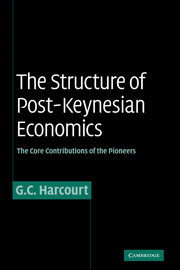
- The Structure of Post-Keynesian EconomicsThe Core Contributions of the Pioneers, pp. 1 - 5Publisher: Cambridge University PressPrint publication year: 2006
Accessibility standard: Unknown
Why this information is here
This section outlines the accessibility features of this content - including support for screen readers, full keyboard navigation and high-contrast display options. This may not be relevant for you.Accessibility Information
Accessibility compliance for the PDF of this chapter is currently unknown
and may be updated in the future.
- 8
- Cited by