Book contents
- Frontmatter
- Contents
- Foreword
- Preface to the third edition
- Table of cases
- Table of international instruments
- List of abbreviations
- Introduction
- 1 The Universal Declaration of Human Rights and recognition of the right to life
- 2 The International Covenant on Civil and Political Rights: drafting, ratification and reservation
- 3 Interpretation of the International Covenant on Civil and Political Rights
- 4 Towards abolition: the Second Optional Protocol and other developments
- 5 International humanitarian law
- 6 International criminal law
- 7 European human rights law
- 8 Inter-American human rights law
- 9 African human rights law
- Conclusion
- Appendices
- Bibliography
- Index
Foreword
Published online by Cambridge University Press: 30 July 2009

Book contents
- Frontmatter
- Contents
- Foreword
- Preface to the third edition
- Table of cases
- Table of international instruments
- List of abbreviations
- Introduction
- 1 The Universal Declaration of Human Rights and recognition of the right to life
- 2 The International Covenant on Civil and Political Rights: drafting, ratification and reservation
- 3 Interpretation of the International Covenant on Civil and Political Rights
- 4 Towards abolition: the Second Optional Protocol and other developments
- 5 International humanitarian law
- 6 International criminal law
- 7 European human rights law
- 8 Inter-American human rights law
- 9 African human rights law
- Conclusion
- Appendices
- Bibliography
- Index
Summary
William Schabas's work on the abolition of the death penalty could not be more timely, offering as it does a broad overview of the legal progress in the field over the last fifty years. In 1948, the Universal Declaration of Human Rights proclaimed the right to life. In 1966, the United Nations Covenant on Civil and Political Rights established that no one shall be arbitrarily deprived of life. It went on to add that in countries where the death penalty has not been abolished, a death sentence can only be pronounced for the most serious crimes in accordance with the law in force at the time of the commission of the crime. In 1989, an additional protocol to the Covenant, abolishing the death penalty in peacetime, was adopted. Thus we have moved from the proclamation of a principle to its regulation, and from regulation of that principle to abolition.
European law underwent an evolution parallel to that of the United Nations. The European Convention on Human Rights specified, in 1950, that
Everyone's right to life shall be protected by law. No one shall be deprived of his life intentionally save in the execution of a sentence of a court following his conviction of a crime for which this penalty is provided by law.
The Sixth Protocol to the Convention abolished, in 1982, the death penalty, except in time of war or imminent danger of war.
In the Western hemisphere, a comparable progress took place.
Information
- Type
- Chapter
- Information
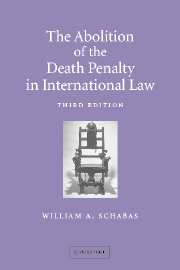
- The Abolition of the Death Penalty in International Law , pp. ix - xiiPublisher: Cambridge University PressPrint publication year: 2002
Accessibility standard: Unknown
Why this information is here
This section outlines the accessibility features of this content - including support for screen readers, full keyboard navigation and high-contrast display options. This may not be relevant for you.Accessibility Information
Accessibility compliance for the PDF of this chapter is currently unknown
and may be updated in the future.