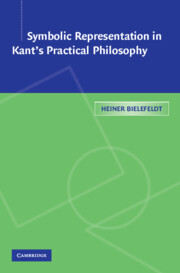
Book contents
- Frontmatter
- Contents
- Citations and Translations
- Acknowledgments
- I INTRODUCTION
- II KANT'S SOCRATIC ENLIGHTENMENT
- III THE LAW OF FREEDOM
- IV HOW TO FIND ORIENTATION IN MORAL PRACTICE
- V THE ORDER OF RIGHTS AS A SYMBOL OF HUMAN DIGNITY
- VI TRACES OF PURPOSIVENESS IN NATURE AND HISTORY
- VII SYMBOLISM IN THE PHILOSOPHY OF RELIGION
- VIII CONCLUSION
- Bibliography
- Index
VI - TRACES OF PURPOSIVENESS IN NATURE AND HISTORY
Published online by Cambridge University Press: 12 July 2009

Book contents
- Frontmatter
- Contents
- Citations and Translations
- Acknowledgments
- I INTRODUCTION
- II KANT'S SOCRATIC ENLIGHTENMENT
- III THE LAW OF FREEDOM
- IV HOW TO FIND ORIENTATION IN MORAL PRACTICE
- V THE ORDER OF RIGHTS AS A SYMBOL OF HUMAN DIGNITY
- VI TRACES OF PURPOSIVENESS IN NATURE AND HISTORY
- VII SYMBOLISM IN THE PHILOSOPHY OF RELIGION
- VIII CONCLUSION
- Bibliography
- Index
Summary
Mediating between Freedom and Nature
Although the moral worth of an action depends on the underlying moral disposition rather than on the success that action might (or might not) have, Kant emphasizes that a good will differs from a “mere wish” in that it requires “the summoning of all means insofar as they are in our control.” A person who takes morality seriously cannot remain indifferent toward the prospects of success or failure of his or her moral efforts. The question of the effectiveness of our moral commitment, although not constituting the basis of morality, can certainly not be dismissed from the realm of moral considerations.
It is indeed a requirement of moral earnestness that we should look for structures in nature and history that can at least give us hope that our moral efforts are not in vain from the outset. The search for such structures in the world on which we may ground moral hope is part of Kant's teleology, which he develops in the Critique of Judgment. Teleology, the doctrine of purposiveness, has a crucial function in the architecture of Kant's philosophy as a whole because it mediates between the order of nature and the order of freedom. The mediating function of teleology derives from the fact that the concept of purposiveness plays a role in both domains.
Information
- Type
- Chapter
- Information
- Symbolic Representation in Kant's Practical Philosophy , pp. 117 - 150Publisher: Cambridge University PressPrint publication year: 2003
Accessibility standard: Unknown
Why this information is here
This section outlines the accessibility features of this content - including support for screen readers, full keyboard navigation and high-contrast display options. This may not be relevant for you.Accessibility Information
Accessibility compliance for the PDF of this chapter is currently unknown
and may be updated in the future.