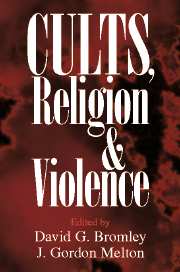
Book contents
- Frontmatter
- Contents
- Acknowledgments
- Contributors
- Prologue
- 1 Violence and Religion in Perspective
- 2 Dramatic Denouements
- 3 Challenging Misconceptions about the New Religions–Violence Connection
- 4 Sources of Volatility in Religious Movements
- 5 Crises of Charismatic Legitimacy and Violent Behavior in New Religious Movements
- 6 Public Agency Involvement in Government–Religious Movement Confrontations
- 7 Watching for Violence: A Comparative Analysis of the Roles of Five Types of Cult-Watching Groups
- 8 Mass Suicide and the Branch Davidians
- 9 Occult Masters and the Temple of Doom: The Fiery End of the Solar Temple
- 10 Dramatic Confrontations: Aum Shinrikyô against the World
- 11 Making Sense of the Heaven's Gate Suicides
- 12 Lessons from the Past, Perspective for the Future
- Index
1 - Violence and Religion in Perspective
Published online by Cambridge University Press: 09 July 2009

Book contents
- Frontmatter
- Contents
- Acknowledgments
- Contributors
- Prologue
- 1 Violence and Religion in Perspective
- 2 Dramatic Denouements
- 3 Challenging Misconceptions about the New Religions–Violence Connection
- 4 Sources of Volatility in Religious Movements
- 5 Crises of Charismatic Legitimacy and Violent Behavior in New Religious Movements
- 6 Public Agency Involvement in Government–Religious Movement Confrontations
- 7 Watching for Violence: A Comparative Analysis of the Roles of Five Types of Cult-Watching Groups
- 8 Mass Suicide and the Branch Davidians
- 9 Occult Masters and the Temple of Doom: The Fiery End of the Solar Temple
- 10 Dramatic Confrontations: Aum Shinrikyô against the World
- 11 Making Sense of the Heaven's Gate Suicides
- 12 Lessons from the Past, Perspective for the Future
- Index
Summary
The relationship between religion and violence has been a subject of rapidly growing interest and concern to social scientists studying a broad range of religious groups and traditions. Violent acts and relationships are extremely diverse, of course, and so it is not surprising that the burgeoning literature on religion and violence incorporates analyses of numerous types of violence, groups, and contexts. A number of distinctions are conventionally drawn in distinguishing forms of violence. Violence is variously conceptualized as an act, a process, or a relationship. Violence may involve individual actions, as in the personal murder of one member of a religious group by another, an outsider by an insider, or an insider by an outsider. It may also involve collective action by or against a group, as in the cases of war, revolution, repression, and terrorism. Violence may or may not explicitly invoke religious objectives. For example, an individual who is a member of a religious group may simply be the perpetrator or victim of an act of violence, with no connection to a religious purpose, or violent acts may have a specific religious goal, such as assassination of a spiritual leader or execution for heresy. Violence may occur within the confines of a group, as in the case of schismatic conflict; it may also occur across institutional boundaries, as when the religious group is the target of political repression or the instigator of an attack against societal institutions.
Information
- Type
- Chapter
- Information
- Cults, Religion, and Violence , pp. 1 - 10Publisher: Cambridge University PressPrint publication year: 2002
Accessibility standard: Unknown
Why this information is here
This section outlines the accessibility features of this content - including support for screen readers, full keyboard navigation and high-contrast display options. This may not be relevant for you.Accessibility Information
Accessibility compliance for the PDF of this chapter is currently unknown
and may be updated in the future.
- 1
- Cited by