Book contents
- Frontmatter
- Contents
- List of Plates
- List of Figures
- List of Contributors
- Acknowledgments
- Preface
- PART I AN INTRODUCTION TO THE SCIENTIFIC STUDY OF MUMMIES
- PART II DIET, DISEASE AND DEATH IN ANCIENT EGYPT: DIAGNOSTIC AND INVESTIGATIVE TECHNIQUES
- 3 Imaging in Egyptian mummies
- 4 Endoscopy and mummy research
- 5 Dental health and disease in ancient Egypt
- 6 Slices of mummy: a histologist's perspective
- 7 Palaeopathology at the beginning of the new millennium: a review of the literature
- 8 The use of immunocytochemistry to diagnose disease in mummies
- 9 DNA identification in mummies and associated material
- 10 An introduction to analytical methods
- 11 The facial reconstruction of ancient Egyptians
- PART III THE TREATMENT OF DISEASE IN ANCIENT EGYPT
- PART IV RESOURCES FOR STUDYING MUMMIES
- PART V THE FUTURE OF BIOMEDICAL AND SCIENTIFIC STUDIES IN EGYPTOLOGY
- References
- Index
6 - Slices of mummy: a histologist's perspective
Published online by Cambridge University Press: 18 August 2009
By
Edited by

Book contents
- Frontmatter
- Contents
- List of Plates
- List of Figures
- List of Contributors
- Acknowledgments
- Preface
- PART I AN INTRODUCTION TO THE SCIENTIFIC STUDY OF MUMMIES
- PART II DIET, DISEASE AND DEATH IN ANCIENT EGYPT: DIAGNOSTIC AND INVESTIGATIVE TECHNIQUES
- 3 Imaging in Egyptian mummies
- 4 Endoscopy and mummy research
- 5 Dental health and disease in ancient Egypt
- 6 Slices of mummy: a histologist's perspective
- 7 Palaeopathology at the beginning of the new millennium: a review of the literature
- 8 The use of immunocytochemistry to diagnose disease in mummies
- 9 DNA identification in mummies and associated material
- 10 An introduction to analytical methods
- 11 The facial reconstruction of ancient Egyptians
- PART III THE TREATMENT OF DISEASE IN ANCIENT EGYPT
- PART IV RESOURCES FOR STUDYING MUMMIES
- PART V THE FUTURE OF BIOMEDICAL AND SCIENTIFIC STUDIES IN EGYPTOLOGY
- References
- Index
Summary
Introduction
The technique of histology has been used for more than a century throughout the world. It is still the basis of modern day pathology for the diagnosis of plant, animal, and human diseases. Histology is also known as microscopic anatomy. The word ‘anatomy’ comes from the Greek ana- meaning ‘up’ or ‘through’ plus tome meaning ‘a cutting.’ Thus, at first, the term ‘anatomy’ meant a ‘cutting up’ procedure because the structure of the body was originally learned through dissecting it with knives.
The word ‘histology’ comes from the Greek histo- meaning ‘tissue’ plus logos meaning ‘treatise.’ Therefore ‘histology’ is a treatise about the tissues and cells of the body. When applied to mummified tissues, it is generally known as ‘palaeohistology,’ a term first used by Moodie (1920). Whereas modern day histology is a diagnostic tool, very different information is sought from the histological examination of the ancient tissues. For example, it is always necessary to identify the type of tissue and its state of preservation. In addition, it is sometimes possible to diagnose diseases and assess the nutritional status of the individual from whom the tissue was taken.
The histology of ancient Egyptian tissues
Techniques of rehydration and fixation
Essentially histology is the production of thin sections of tissue that can be stained and examined with a microscope. The major disadvantage of histological investigation of ancient tissues is that the samples examined are destroyed and can never be returned to the body.
Information
- Type
- Chapter
- Information
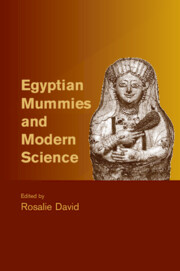
- Egyptian Mummies and Modern Science , pp. 71 - 82Publisher: Cambridge University PressPrint publication year: 2008
Accessibility standard: Unknown
Why this information is here
This section outlines the accessibility features of this content - including support for screen readers, full keyboard navigation and high-contrast display options. This may not be relevant for you.Accessibility Information
Accessibility compliance for the PDF of this chapter is currently unknown
and may be updated in the future.
- 2
- Cited by