Book contents
- Frontmatter
- Contents
- List of Plates
- List of Figures
- List of Contributors
- Acknowledgments
- Preface
- PART I AN INTRODUCTION TO THE SCIENTIFIC STUDY OF MUMMIES
- PART II DIET, DISEASE AND DEATH IN ANCIENT EGYPT: DIAGNOSTIC AND INVESTIGATIVE TECHNIQUES
- PART III THE TREATMENT OF DISEASE IN ANCIENT EGYPT
- 12 The ancient Egyptian medical system
- 13 Intoxicants in ancient Egypt? opium, nymphea, coca and tobacco
- 14 Pharmacy in ancient Egypt
- PART IV RESOURCES FOR STUDYING MUMMIES
- PART V THE FUTURE OF BIOMEDICAL AND SCIENTIFIC STUDIES IN EGYPTOLOGY
- References
- Index
14 - Pharmacy in ancient Egypt
Published online by Cambridge University Press: 18 August 2009
Edited by

Book contents
- Frontmatter
- Contents
- List of Plates
- List of Figures
- List of Contributors
- Acknowledgments
- Preface
- PART I AN INTRODUCTION TO THE SCIENTIFIC STUDY OF MUMMIES
- PART II DIET, DISEASE AND DEATH IN ANCIENT EGYPT: DIAGNOSTIC AND INVESTIGATIVE TECHNIQUES
- PART III THE TREATMENT OF DISEASE IN ANCIENT EGYPT
- 12 The ancient Egyptian medical system
- 13 Intoxicants in ancient Egypt? opium, nymphea, coca and tobacco
- 14 Pharmacy in ancient Egypt
- PART IV RESOURCES FOR STUDYING MUMMIES
- PART V THE FUTURE OF BIOMEDICAL AND SCIENTIFIC STUDIES IN EGYPTOLOGY
- References
- Index
Summary
Introduction
Pharmacy is the practice of sourcing, preparing and dispensing pharmaceutical preparations to treat ailments. The use of medicinal plants as remedies, from ancient to current times, precedes any formal medical record knowledge being transmitted from generation to generation. This is manifested in traditional medicine today, in which treatments are characteristic of a local community.
This century has witnessed a revived interest in natural drug resources and the reestablishment of sustainable species to satisfy demand (Demerdash 2001). Herbal remedies are now regulated (British Herbal Pharmacopoeia), whereas scientific interest focuses on pharmacognosy and pharmacology (Evans 2002).
The classical history of pharmacy
History attributes medicine to Hippocrates, c. 460 b.c., and drugs to the mythical Chiron. Asclepiades (100 b.c.) communicated Hippocratic medicine to Rome whilst Dioscorides (c. 50 a.d.) compiled the first pharmacopoeia of 500 drugs (Gunther 1934). His contemporary, Pliny, wrote of medicinal plants, whereas Celsus recorded the materia medica of the Roman world. In c. 150 a.d., Galen developed pharmacy, thereby influencing medicine for 1,500 years (Brock 1952; Sarton 1954; Nutton 2001). In the fifth century a.d., Oribasius translated Galenic texts into Syriac, which remained medical doctrine for 200 years. When Islam united Near Eastern countries under one religion in the seventh century a.d., Galen's teachings were embraced (Elgood 1951) and continued to influence Arabic medicine until the eleventh century.
Avicenna combined Galenic tradition with Persian medicine, which had its origins in the Code of Hammurabi, c. 1950 b.c. (Sigerist 1987:386).
Information
- Type
- Chapter
- Information
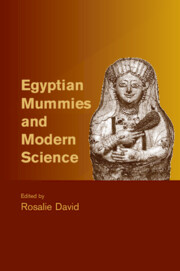
- Egyptian Mummies and Modern Science , pp. 216 - 234Publisher: Cambridge University PressPrint publication year: 2008
Accessibility standard: Unknown
Why this information is here
This section outlines the accessibility features of this content - including support for screen readers, full keyboard navigation and high-contrast display options. This may not be relevant for you.Accessibility Information
Accessibility compliance for the PDF of this chapter is currently unknown
and may be updated in the future.
- 5
- Cited by