Book contents
- Frontmatter
- Contents
- Acknowledgments
- 1 Introduction
- 2 Agreeing on Things
- 3 Moving People, Objects, and Ideas
- 4 Making Stone Vessels
- 5 The Third Millennium
- 6 The Earlier Second Millennium
- 7 The Later Second Millennium
- 8 The Rough and the Smooth: Stone Vessels from a Comparative Perspective
- 9 Forging Value and Casting Stones
- Appendix
- Notes
- Bibliography
- Index
1 - Introduction
Published online by Cambridge University Press: 14 August 2009

Book contents
- Frontmatter
- Contents
- Acknowledgments
- 1 Introduction
- 2 Agreeing on Things
- 3 Moving People, Objects, and Ideas
- 4 Making Stone Vessels
- 5 The Third Millennium
- 6 The Earlier Second Millennium
- 7 The Later Second Millennium
- 8 The Rough and the Smooth: Stone Vessels from a Comparative Perspective
- 9 Forging Value and Casting Stones
- Appendix
- Notes
- Bibliography
- Index
Summary
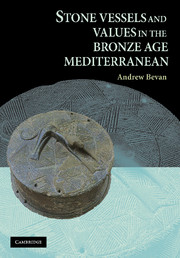
This book examines the role of stone vessels throughout the eastern Mediterranean and over a period of two millennia during the Bronze Age (ca. 3000–1200 BC). This period and region saw perhaps the most prolific and diverse tradition of such objects in human history and their treatment as a group represents an unusual interpretative opportunity. Stone vessels offer important analytical advantages over other classes of material, making them a favourable vantage from which to consider concepts of object value and how they might be approached in the archaeological record. Although comparative longitudinal studies like this one are increasingly rare, they provide a clarity which a narrower focus does not and are the type of contribution to the social sciences that archaeology is particularly well placed to provide. The following discussion addresses why a seemingly straightforward object-based analysis might offer wider archaeological insight, especially with regard to object value. It then goes on to justify the scope and coverage of the book before setting some relevant terms for comparative analysis. Finally, it outlines the main focus of each the succeeding chapters.
Stone vessels offer interpretative advantages over most other classes of material culture for at least five reasons: (1) their virtual indestructibility, (2) the subtractive properties of stone, (3) the potential for macroscopic, petrographic, or geochemical provenancing, (4) their numbers and regional diversity within the Bronze Age eastern Mediterranean, and (5) their flexible range of values and functions.
Information
- Type
- Chapter
- Information
- Publisher: Cambridge University PressPrint publication year: 2007
Accessibility standard: Unknown
Why this information is here
This section outlines the accessibility features of this content - including support for screen readers, full keyboard navigation and high-contrast display options. This may not be relevant for you.Accessibility Information
Accessibility compliance for the PDF of this chapter is currently unknown
and may be updated in the future.
- 1
- Cited by