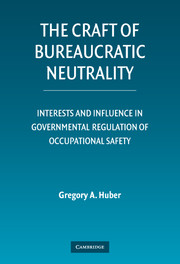
 The Craft of Bureaucratic Neutrality
 Interests and Influence in Governmental Regulation of Occupational Safety
Introduction
Published online by Cambridge University Press: 27 July 2009

Summary
How can one reconcile the apparent conflict between political understandings of bureaucracy and Weberian conceptions of administrative neutrality? As universal explanations, neither claim – that administration is intrinsically political or that it is purely impartial – is satisfactory. Government agencies at times implement the law in ways that seem rife with political considerations, while at other times the machinations of administration seem largely technocratic and above the political fray. What, however, are the appropriate boundaries of, and interactions between, each characterization?
The argument advanced here is that the stark dichotomy between political and bureaucratic understandings of administrative behavior is a false one. By adopting the language of neutrality and efficiency at the core of the Weberian account of neutrally competent modern bureaucracy, administrative agencies can serve political ends. Agency leaders guide how the law is implemented through internal management practices that seek to minimize both agency inefficiency and the susceptibility of lower-level bureaucrats to outside influences. In critical ways, then, subordinate bureaucrats exemplify Weber's description of “[t]he ‘objective’ discharge of business … according to calculable rules and ‘without regard for persons’” (1946: 215). At the same time, centralized administrative decisions move implementation away from “pure” neutrality to something more strategically valuable for agency leaders.
In sum, “strategic neutrality” is an implementation practice that simultaneously serves agency leaders' management and political needs. It helps guide public policy toward desired ends while minimizing the likelihood that outsiders will gain sufficient political strength to overrule agency decisions.
Information
- Type
- Chapter
- Information
- The Craft of Bureaucratic NeutralityInterests and Influence in Governmental Regulation of Occupational Safety, pp. 1 - 12Publisher: Cambridge University PressPrint publication year: 2007
Accessibility standard: Unknown
Why this information is here
This section outlines the accessibility features of this content - including support for screen readers, full keyboard navigation and high-contrast display options. This may not be relevant for you.Accessibility Information
Accessibility compliance for the PDF of this chapter is currently unknown
and may be updated in the future.
- 1
- Cited by