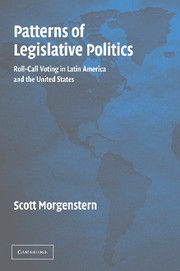
Book contents
- Frontmatter
- Contents
- Tables and Figures
- Preface and Acknowledgments
- Party, Faction, and Coalition Names and Abbreviations
- 1 Patterns of Legislative Politics: Identifiability and Flexibility
- 2 Representation and the Agent System
- 3 Identifying Agents
- 4 Influences on Agent Unity: Discipline and Cohesion
- 5 Explaining Voting Unity
- 6 Policy Coalitions and Agent Flexibility
- 7 Conclusion
- Bibliography
- Subject Index
- Author Index
2 - Representation and the Agent System
Published online by Cambridge University Press: 24 July 2009

Book contents
- Frontmatter
- Contents
- Tables and Figures
- Preface and Acknowledgments
- Party, Faction, and Coalition Names and Abbreviations
- 1 Patterns of Legislative Politics: Identifiability and Flexibility
- 2 Representation and the Agent System
- 3 Identifying Agents
- 4 Influences on Agent Unity: Discipline and Cohesion
- 5 Explaining Voting Unity
- 6 Policy Coalitions and Agent Flexibility
- 7 Conclusion
- Bibliography
- Subject Index
- Author Index
Summary
Representation requires that voters choose delegates and then hold them accountable for their actions. This relationship implies that the delegates act as agents of the voters. In some cases the voters will see their local representative as their agent; in others the voters can rationally aim their protests or praise toward factions, parties, coalitions, or local delegations. As I argued in Chapter 1, roll-call data show whether parties, factions, or coalitions can be held collectively responsible – or whether voters are more clearly represented by individual legislators.
Representation is not just a function of the relationship between voters and legislators. Interest groups, the executive, and coalition builders direct their time, money, and energy toward the individual or group whom they see as responsible for policy outcomes. Again, these principals do not necessarily see parties as their agents.
Since parties are not always the most relevant political or legislative actors in a system, the generic term “party system” can be misleading in terms of descriptions and explanations in comparative analysis. In this chapter, therefore, I propose to substitute a more neutral label, the “agent system,” in its place.
Party-centric theories are unfounded where parties cannot make or enforce decisions. It is well recognized that not all parties have the requisite organization and strong leaders to act collectively. As Panebianco (1988) described, party leadership types range from “concentrated” to “diffuse.”
Information
- Type
- Chapter
- Information
- Patterns of Legislative PoliticsRoll-Call Voting in Latin America and the United States, pp. 26 - 40Publisher: Cambridge University PressPrint publication year: 2003
Accessibility standard: Unknown
Why this information is here
This section outlines the accessibility features of this content - including support for screen readers, full keyboard navigation and high-contrast display options. This may not be relevant for you.Accessibility Information
Accessibility compliance for the PDF of this chapter is currently unknown
and may be updated in the future.