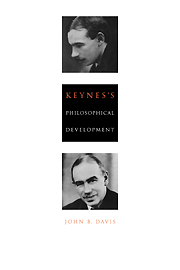
Book contents
- Frontmatter
- Contents
- Preface
- Introduction: Keynes and philosophy
- 1 Keynes's early intuitionism
- 2 The dilemmas of Moore's Principia for ethics and economics
- 3 Keynes's self-critique
- 4 Keynes's later philosophy
- 5 The philosophical thinking of The General Theory
- 6 Ethics and policy
- Conclusion: Keynes's philosophical development
- Notes
- References
- Index
5 - The philosophical thinking of The General Theory
Published online by Cambridge University Press: 28 August 2009

Book contents
- Frontmatter
- Contents
- Preface
- Introduction: Keynes and philosophy
- 1 Keynes's early intuitionism
- 2 The dilemmas of Moore's Principia for ethics and economics
- 3 Keynes's self-critique
- 4 Keynes's later philosophy
- 5 The philosophical thinking of The General Theory
- 6 Ethics and policy
- Conclusion: Keynes's philosophical development
- Notes
- References
- Index
Summary
The criticisms addressed to Keynes's earlier philosophical thinking as initiated by Ramsey together with Keynes's own sense of the limitations of his earlier philosophy led Keynes to reformulate the central concept of his early philosophy, the concept of intuition. Yet clearly what dominated Keynes's intellectual development in the years subsequent to his initial concern with philosophy was his struggle with the problems of economic theory and policy (Clarke, 1989; Moggridge, 1992; Skidelsky, 1992). This conceptual terrain was almost entirely removed from the language and interests of Keynes's early philosophy, and indeed philosophy in general, so that it cannot be said that Keynes's intellectual development was directly focused upon matters of philosophical significance, as might have been the case had his career taken the path upon which it had originally embarked. Keynes's philosophical development, it could indeed be said, proceeded at two removes from the usual objects and preoccupations of philosophy. It did not make the traditional problems of philosophy its primary vehicle, and it also required translation behind the scenes, as it were, from one set of issues and way of thinking about economics to another. Despite this, Keynes's attachment to philosophical thinking as established in his first years at Cambridge, together with his natural talent for abstract thought, rendered the philosophical dimensions of his later work always immediate to his overall reasoning process. Accordingly, though his philosophical conclusions became increasingly implicit in his later writing, they were no less serious commitments on his part, only more difficult to discern.
Information
- Type
- Chapter
- Information
- Keynes's Philosophical Development , pp. 120 - 147Publisher: Cambridge University PressPrint publication year: 1994
Accessibility standard: Unknown
Why this information is here
This section outlines the accessibility features of this content - including support for screen readers, full keyboard navigation and high-contrast display options. This may not be relevant for you.Accessibility Information
Accessibility compliance for the PDF of this chapter is currently unknown
and may be updated in the future.