Book contents
- Frontmatter
- Contents
- Maps
- To my parents
- Acknowledgements
- Note On Transliteration
- INTRODUCTION
- 1 BULGAR
- 2 THE RUS'
- 3 NOVGOROD: THE SQUIRREL FUR TRADE
- 4 MOSCOW AND KAZAN': THE LUXURY FUR TRADE
- 5 THE POLITICAL SIGNIFICANCE OF THE FUR TRADE
- 6 THE ECONOMIC SIGNIFICANCE OF THE FUR TRADE
- CONCLUSION
- Notes
- Bibliography
- Index
4 - MOSCOW AND KAZAN': THE LUXURY FUR TRADE
Published online by Cambridge University Press: 29 October 2009
Book contents
- Frontmatter
- Contents
- Maps
- To my parents
- Acknowledgements
- Note On Transliteration
- INTRODUCTION
- 1 BULGAR
- 2 THE RUS'
- 3 NOVGOROD: THE SQUIRREL FUR TRADE
- 4 MOSCOW AND KAZAN': THE LUXURY FUR TRADE
- 5 THE POLITICAL SIGNIFICANCE OF THE FUR TRADE
- 6 THE ECONOMIC SIGNIFICANCE OF THE FUR TRADE
- CONCLUSION
- Notes
- Bibliography
- Index
Summary
The final arrangement of fur trade patterns prior to the Russian conquest of Siberia centered around two markets, Moscow and Kazan’. Moscow initially developed its fur trade while under the suzerainty of the Golden Horde. Kazan’ emerged in a parallel capacity only in the wake of the Horde's power. For a century the two centers conducted a trade in luxury fur that overlapped and competed. In the middle of the sixteenth century, however, the fur trade generated from the two centers finally merged. When Moscow annexed Kazan’, it gained full control of the latter's fur supplies as well as its export trade to the south and east. Moscow then dominated that sector as well as its own southern trade and the European trade, which it had already acquired by displacing Novgorod. Thus, by the mid-sixteenth century, Moscow had established itself as the exclusive authority over the fundamental elements of easternmost Europe's fur trade network.
MOSCOW'S ENTRY INTO THE FUR TRADE
When the Mongols invaded the Russian lands between 1237 and 1240, the fur trade network generated from that part of eastern Europe since the tenth century had already fragmented. Novgorod and Bulgar, the two centers whose supply and export patterns had augmented one another, were separated by the recently established principality of Rostov–Suzdal', which interfered with their fur exchange. Kiev, the third center in the early fur trade network, was declining in both political and economic significance.
Information
- Type
- Chapter
- Information
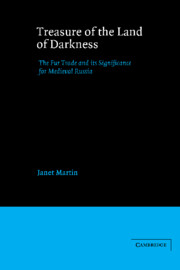
- Treasure of the Land of DarknessThe Fur Trade and its Significance for Medieval Russia, pp. 86 - 109Publisher: Cambridge University PressPrint publication year: 1986
Accessibility standard: Unknown
Why this information is here
This section outlines the accessibility features of this content - including support for screen readers, full keyboard navigation and high-contrast display options. This may not be relevant for you.Accessibility Information
Accessibility compliance for the PDF of this chapter is currently unknown
and may be updated in the future.