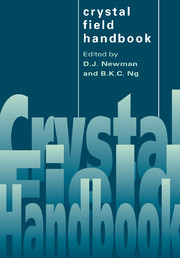
Book contents
- Frontmatter
- Contents
- List of contributors
- Preface
- Introduction
- 1 Crystal field splitting mechanisms
- 2 Empirical crystal fields
- 3 Fitting crystal field parameters
- 4 Lanthanide and actinide optical spectra
- 5 Superposition model
- 6 Effects of electron correlation on crystal field splittings
- 7 Ground state splittings in S-state ions
- 8 Invariants and moments
- 9 Semiclassical model
- 10 Transition intensities
- Appendix 1 Point symmetry
- Appendix 2 QBASIC programs
- Appendix 3 Accessible program packages
- Appendix 4 Computer package CST
- Bibliography
- Index
9 - Semiclassical model
Published online by Cambridge University Press: 10 December 2009
By

Book contents
- Frontmatter
- Contents
- List of contributors
- Preface
- Introduction
- 1 Crystal field splitting mechanisms
- 2 Empirical crystal fields
- 3 Fitting crystal field parameters
- 4 Lanthanide and actinide optical spectra
- 5 Superposition model
- 6 Effects of electron correlation on crystal field splittings
- 7 Ground state splittings in S-state ions
- 8 Invariants and moments
- 9 Semiclassical model
- 10 Transition intensities
- Appendix 1 Point symmetry
- Appendix 2 QBASIC programs
- Appendix 3 Accessible program packages
- Appendix 4 Computer package CST
- Bibliography
- Index
Summary
The semiclassical, or tunnelling, model of crystal fields was introduced by Trammel [Tra63] as an heuristic aid in understanding the magnetic ordering in lanthanide phosphides. Pytte and Stevens [PS71] subsequently used this model to describe Jahn Teller ordering in lanthanide vanadates.
The semiclassical model also provides an explanation of the eightfold clusters of energy levels observed in the ground multiplets of holmium and erbium in both garnets [JDR69, OH69] and superconducting cuprates [FBU88a, FBU88b, SLK92] (see Section 9.3). The usual reason for the clustering of enery levels, viz. the existence of an approximate higher symmetry, cannot be relevant, as no site symmetry higher than cubic is possible (see Appendix 1).
Trammel [Tra63] explained clustering in terms of the preferred alignment of a classical angular momentum vector along the directions of minima in the crystal field potential. A quantitative version of the semiclassical model was subsequently developed by Harter and Patterson [HP79] to explain the even more pronounced clustering that is observed in the rotational energy levels of polyatomic molecules. The semiclassical model is very accurate for molecular rotational energies, mainly because the states of interest have very large angular momenta. While it is necessary to be selective in applying the model to crystal field splittings, where the angular momenta are relatively small, it can occasionally be very useful indeed, as this chapter seeks to demonstrate.
Information
- Type
- Chapter
- Information
- Crystal Field Handbook , pp. 176 - 189Publisher: Cambridge University PressPrint publication year: 2000
Accessibility standard: Unknown
Why this information is here
This section outlines the accessibility features of this content - including support for screen readers, full keyboard navigation and high-contrast display options. This may not be relevant for you.Accessibility Information
Accessibility compliance for the PDF of this chapter is currently unknown
and may be updated in the future.
- 1
- Cited by