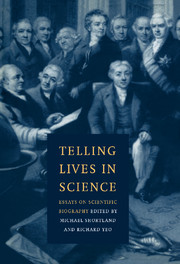
Book contents
- Frontmatter
- Contents
- List of contributors
- Preface
- Introduction
- 1 Existential projects and existential choice in science: science biography as an edifying genre
- 2 Life-paths: autobiography, science and the French Revolution
- 3 From science to wisdom: Humphry Davy's life
- 4 Robert Boyle and the dilemma of biography in the age of the Scientific Revolution
- 5 Alphabetical lives: scientific biography in historical dictionaries and encyclopaedias
- 6 The scientist as hero: public images of Michael Faraday
- 7 ‘Tactful organising and executive power’: biographies of Florence Nightingale for girls
- 8 Taking histories, medical lives: Thomas Beddoes and biography
- 9 The scientist as patron and patriotic symbol: the changing reputation of Sir Joseph Banks
- 10 Metabiographical reflections on Charles Darwin
- Index
5 - Alphabetical lives: scientific biography in historical dictionaries and encyclopaedias
Published online by Cambridge University Press: 28 October 2009
By

Book contents
- Frontmatter
- Contents
- List of contributors
- Preface
- Introduction
- 1 Existential projects and existential choice in science: science biography as an edifying genre
- 2 Life-paths: autobiography, science and the French Revolution
- 3 From science to wisdom: Humphry Davy's life
- 4 Robert Boyle and the dilemma of biography in the age of the Scientific Revolution
- 5 Alphabetical lives: scientific biography in historical dictionaries and encyclopaedias
- 6 The scientist as hero: public images of Michael Faraday
- 7 ‘Tactful organising and executive power’: biographies of Florence Nightingale for girls
- 8 Taking histories, medical lives: Thomas Beddoes and biography
- 9 The scientist as patron and patriotic symbol: the changing reputation of Sir Joseph Banks
- 10 Metabiographical reflections on Charles Darwin
- Index
Summary
Theophilus Hopkins was a moderately famous man. You can look him up in the 1860 Britannica. There are three full columns about his corals and his corallines, his anemones and starfish. It does not have anything very useful to say about the man. It does not tell you what he was like. You can read it three times over and never guess that he had any particular attitude to Christmas pudding.
Peter Carey, Oscar and Lucinda, 1988, p.7Today we conventionally consult encyclopaedias for biographical information. Probably at least as many readers seek this in the Encyclopaedia Britannica as in the Dictionary of National Biography, or Who's Who, or other specialist biographical dictionaries. But in the famous encyclopaedias of the Enlightenment such biographical information was absent. Neither Ephraim Chambers's Cyclopaedia of 1728 nor the more renowned Encyclopedie (1751–80) edited by Denis Diderot and Jean D'Alembert, contained any biographical entries: when personal names appear these usually represent some larger intellectual doctrine, such as Baconianism, Cartesianism, or Newtonianism. From the early nineteenth century encyclopaedias began to include the biographical entries we now expect. However in its 1985 revision, the Britannica decided to relegate all biographical articles from its Macropaedia to the Micropaedia, except for those on ‘100 people who profoundly affected world history’. This was a departure from its previous twentieth-century editions, but still a long way from the rigorous exclusion practised by its eighteenth-century predecessors.
Information
- Type
- Chapter
- Information
- Telling Lives in ScienceEssays on Scientific Biography, pp. 139 - 170Publisher: Cambridge University PressPrint publication year: 1996
Accessibility standard: Unknown
Why this information is here
This section outlines the accessibility features of this content - including support for screen readers, full keyboard navigation and high-contrast display options. This may not be relevant for you.Accessibility Information
Accessibility compliance for the PDF of this chapter is currently unknown
and may be updated in the future.
- 3
- Cited by