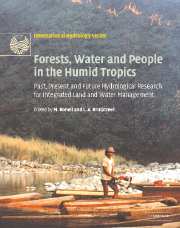
 Forests, Water and People in the Humid Tropics
 Past, Present and Future Hydrological Research for Integrated Land and Water Management
Book contents
- Frontmatter
- Contents
- List of contributors
- Foreword
- Preface
- Acknowledgements
- Symposium and Workshop
- Introduction
- Part I Current trends and perspectives on people–land use–water issues
- Part II Hydrological processes in undisturbed forests
- Part III Forest disturbance, conversion and recovery
- 19 Natural disturbances and the hydrology of humid tropical forests
- 20 Spatially significant effects of selective tropical forestry on water, nutrient and sediment flows: a modelling-supported review
- 21 Effects of shifting cultivation and forest fire
- 22 Soil and water impacts during forest conversion and stabilisation to new land use
- 23 Large-scale hydrological impacts of tropical forest conversion
- 24 Forest recovery in the humid tropics: changes in vegetation structure, nutrient pools and the hydrological cycle
- 25 The hydrological and soil impacts of forestation in the tropics
- 26 The potential of agroforestry for sustainable land and water management
- Part IV New methods for evaluating effects of land-use change
- Part V Critical appraisals of best management practices
- Conclusion: Forests, water and people in the humid tropics: an emerging view
- Plate section
- References
26 - The potential of agroforestry for sustainable land and water management
from Part III - Forest disturbance, conversion and recovery
Published online by Cambridge University Press: 12 January 2010

Book contents
- Frontmatter
- Contents
- List of contributors
- Foreword
- Preface
- Acknowledgements
- Symposium and Workshop
- Introduction
- Part I Current trends and perspectives on people–land use–water issues
- Part II Hydrological processes in undisturbed forests
- Part III Forest disturbance, conversion and recovery
- 19 Natural disturbances and the hydrology of humid tropical forests
- 20 Spatially significant effects of selective tropical forestry on water, nutrient and sediment flows: a modelling-supported review
- 21 Effects of shifting cultivation and forest fire
- 22 Soil and water impacts during forest conversion and stabilisation to new land use
- 23 Large-scale hydrological impacts of tropical forest conversion
- 24 Forest recovery in the humid tropics: changes in vegetation structure, nutrient pools and the hydrological cycle
- 25 The hydrological and soil impacts of forestation in the tropics
- 26 The potential of agroforestry for sustainable land and water management
- Part IV New methods for evaluating effects of land-use change
- Part V Critical appraisals of best management practices
- Conclusion: Forests, water and people in the humid tropics: an emerging view
- Plate section
- References
Summary
INTRODUCTION
Improving the efficiency of land and water resource use
Much of the future increase in food and wood production in the humid tropics (and elsewhere), necessary to meet the needs of increasing populations and to reduce hunger and poverty, will have to be achieved from land and water resources already in use. Field observation shows that the extent of the ‘land balance’ – land that could be used for productive purposes but is not currently in use – is very limited. Estimates by FAO and associated organisations appear to show substantial areas which are cultivable but not presently cultivated (Alexandratos, 1995; Bot et al., 2000). However, the validity of these estimates has recently been challenged, suggesting that the ‘land balance’ may be 50% or less of that in the official estimates (Young, 1998; 2000). Moreover, a large proportion of the ‘land balance’ is under forest, for example in Brazil, Congo Democratic Republic (formerly Zaire), Indonesia, Peru and Venezuela, clearance of which is strongly opposed for reasons of environment and biodiversity (Alexandratos, 1995).
The above ‘land balance’ issue focuses the associated research agenda on the challenge of improving the efficiency with which existing land and water resources are used. Over the past half-century, great progress has been achieved in this respect. In agriculture, this has been through the advances generally referred to as the green revolution; in forestry, it has been brought about through a variety of improvements in forest management systems, including fast-growing, high-yielding plantations, and by means of genetic improvement.
Information
- Type
- Chapter
- Information
- Forests, Water and People in the Humid TropicsPast, Present and Future Hydrological Research for Integrated Land and Water Management, pp. 652 - 670Publisher: Cambridge University PressPrint publication year: 2005
References
Alexandratos, N. (1995) World agriculture: towards 2010. An FAO study. Chichester, UK: Wiley, for FAO
(1983) Seasonal estimates of transpiration from a millet crop using a porometer. Agricultural and Forest Meteorology 30: 13–24CrossRefGoogle Scholar
, (1989) Soil characteristics and classification in relation to the mineral nutrition of of tropical wooded ecosystems. In Proctor (1989, q.v.), 15–26Google Scholar
, , , and (1994) Effect of intercropping maize and closely spaced Leucaena hedgerows on soil conservation and maize yield on a steep slope at Ntcheu, Malawi. Agroforestry Systems 27, 17–22CrossRefGoogle Scholar
(1987) Advantages, disadvantages and desirable characteristics of shade trees for coffee, cacao and tea. Agroforestry Systems 5, 3–13CrossRefGoogle Scholar
, , , et al. (1990) Modelling agroforestry systems of cacao (Theobroma cacao) with laurel (Cordia alliodora) or poro (Erythrina poeppigiana) in Costa Rica. V. Productivity indices, organic material models and sustainability over 10 years. Agroforestry Systems 12, 229–249CrossRefGoogle Scholar
Belsky, A. J. and Amundson, R. G. (1997) Influence of savannah trees and shrubs on understorey grasses and soils: new directions in research. In: Carbon and Nutrient Dynamics in Natural and Agricultural Tropical Ecosystems (Eds. Bergstrom, L. and Kirchmann, H.) pp 153–171, CAB International, Wallingford, UK
Bot, A. J., Nachtergaele, F. O. and Young, A. (2000) Land resource potential and constraints at regional and country levels. World Soil Resources Report 90. Rome: FAO
, , and (1990) Biological nitrogen fixation in agroforestry – an overview. Transactions of the 14th International Congress of Soil Science, 3, 170–175Google Scholar
Brenner, A. J., 1996. Micro-climatic modifications in Agroforestry. In: Tree-crop interactions – a physiological approach (Eds. Ong, C. K., and Huxley, P. A.) CAB International, Wallingford, UK, pp 159–187
(1989) Nutrient cycling in moist tropical forests: the hydrological framework. In Proctor (1989, q.v.), 383–415Google Scholar
Bruijnzeel, L. A. (1991) Nutrient input-output budgets of tropical forest ecosystems. Journal of Tropical Ecology 7, 1–24CrossRef
and (eds.) 1999. The science and practice of short-term improved fallows. Agroforestry Systems 47, 1–358CrossRefGoogle Scholar
and (1997) Soil improvement by trees in sub-Saharan Africa. Agroforestry Systems 38, 51–76CrossRefGoogle Scholar
, , and (1998) Redistribution of water within plant root systems. Oceologia 115, 306–311CrossRefGoogle Scholar
Cadish, G. and Giller, K. R. (eds.) (1996) Driven by nature: plant litter quality and decomposition. Wallingford, UK: CAB International
and 1979. Land-use and upland water resources in Britain-a strategic look. Water Resources Bulletin, 15, 1628–1639CrossRefGoogle Scholar
, and (1996) The central agroforestry hypothesis: the trees must acquire resources that the crop would not otherwise acquire. Agroforestry Systems, 34, 27–31CrossRefGoogle Scholar
, , , and (1996) Agroforestry and the mitigation of land degradation in the humid and sub-humid tropics of Africa. Experimental Agriculture 32, 235–290CrossRefGoogle Scholar
, , and (1992a) Above and below-ground interactions in a leucaena/millet alley cropping system. 2. Light interception and dry matter production. Agricultural and Forest Meteorology 60, 73–91CrossRefGoogle Scholar
, , and (1992b) Above and below-ground interactions in a leucaena/millet alley cropping system. 1. Experimental design, instrumentation and diurnal trends. Agricultural and Forest Meteorology 60, 53–72CrossRefGoogle Scholar
, , , and (1993) Energy and water budgets of an area of patterned woodland in the Sahel. Agricultural and Forest Meteorology 66, 65–80CrossRefGoogle Scholar
, and (1992) Biological nitrogen fixation in trees in agro-ecosystems. Plant and Soil 141, 177–196CrossRefGoogle Scholar
(1993) Hydraulic lift and water use by plants: implications for water balance, performance and plant-plant interactions. Oceologia 95, 565–574CrossRefGoogle ScholarPubMed
(1986) Designing agricultural ecosystems for the humid tropics. Ann Rev Ecol and Syst, 17, 245–271CrossRefGoogle Scholar
(1993) A case of farmer adaptation and adoption of contour hedgerows for soil conservation. Experimental Agriculture 29, 97–105CrossRefGoogle Scholar
and (1993) Processes involving intercrop productivity and yields of component crops. Field Crops Res 34, 247–271CrossRefGoogle Scholar
Garrity, D. P. (1996) Tree-crop-soil interactions on slopes. In Tree-crop interactions: a physiological approach (ed. C. K. Ong and P. Huxley, CAB International, Wallingford, UK), 299–318
, and (1995) Estimating sparse forest rainfall interception with an analytical model. Journal of Hydrology, 170, 79–86CrossRefGoogle Scholar
(1996) Approaches to modelling the uptake of water and nutrients in agroforestry systems. Agroforestry Systems 34, 51–65CrossRefGoogle Scholar
Golley, F. B., McGinnis, J. T., Clements, R. G., Child, G. I. and Duever, M. J. (1975). Mineral cycling in a tropical moist forest ecosystem. University Georgia Press, Athens. 248 pp
(1960) Rainfall interception by a tropical rainforest in Uganda. East African Agricultural Journal 25, 255–258CrossRefGoogle Scholar
, , and (1997) Using sap flow gauges to quantify water uptake by tree roots from beneath the crop rooting zone in agroforestry systems. Agroforestry Systems 35, 15–29CrossRefGoogle Scholar
Hudson, N. W. (1995) Soil conservation. Batsford, London
Huntley, B. J. and Walker, B. H. (ed) (1982) Ecology of Tropical Savannas. Springer Verlag, Berlin, pp 669CrossRef
ICRAF (1993) International Centre for Research in Agroforestry. Annual Report 1993. Nairobi: ICRAF
, , , and (1989) Modelling agroforestry systems of cacao (Theobroma cacao) with laurel (Cordia alliodora) and cacao with poro (Erthrina poeppigiana) in Costa Rica IV. Water balances. Agroforestry Systems 8, 267–287CrossRefGoogle Scholar
and (1999) Soil evaporation measurements in an agroforestry system in Kenya. Agricultural and Forest Meteorology 94, 203–215CrossRefGoogle Scholar
(2000) Measured and modelled rainfall interception loss from an agroforestry system in Kenya. Agricultural and Forest Meteorology 100, 323–336CrossRefGoogle Scholar
, and (2000) Tree pruning as a means of controlling water use in an agroforestry system in Kenya. Forest Ecology and Management 126, 133–148CrossRefGoogle Scholar
, , and (1988) The vertical root distribution of fine roots of five tree species and maize in Morogoro, Tanzania. Agroforestry Systems 6, 63–69CrossRefGoogle Scholar
Jordan, C. F., Gajeseni, J. and Watanabe, H. (eds.) (1992) Taungya: forest plantations in South East Asia. Wallingford, UK: CAB International
, and (1992) Karite (Vitellaria paradoxa) and nere (Parkia biglobosa) associated with crops in South Mali. Agroforestry Systems 18, 89–105CrossRefGoogle Scholar
and (1994) Management of agroforestry for the conservation and utilization of land and water resources. Outlook on Agriculture 23, 17–25CrossRefGoogle Scholar
Kiepe, P. (1995a) No runoff, no soil loss: soil and water conservation in hedgerow barrier systems. Tropical Resource Management Papers 10. Wageningen, Netherlands: Agricultural University
(1995b) Effect of Cassia siamea hedgerow barriers on soil physical properties. Geoderma 66, 113–120CrossRefGoogle Scholar
and (1996) A low cost heat pulse method for measuring tree root water uptake. Agroforestry For 7(2):19–22Google Scholar
, , . (1995) Restoration of natural vegetation in degraded Imperata cylindrical grassland: understorey development in forest plantations. Journal of Vegetation Science 6, 205–210CrossRefGoogle Scholar
and (1994) The effect of short rotation Sesbania sesban planted fallows on maize yield. Forestry Ecology and Management 64, 199–208CrossRefGoogle Scholar
Lal, R. (1991) Current research on crop water balance and implications for the future. In: Soil Water Balance in the Sudano-Sahelian Zone (Eds. M. V. K. Sivakumar, J. S. Wallace, C. Renard and C. Giroux) Proc. Int. Workshop, Niamey, Niger, February 1991) IAHS Publ. no. 199, 31–44. IAHS Press. Institute of Hydrology, Wallingford, UK
, , , and (1992) The impact of soil fauna on the properties of soils in the humid tropics. In: Myths and Science of Soils of the Tropics. Soil Science Society of America Special Publication 29, 157–185Google Scholar
and (1999) Agroforestry for water management in southern Australia. Agroforestry Systems 45, 277–302CrossRefGoogle Scholar
, , and (1988) The measurement and modelling of rainfall interception by Amazonian rainforest. Agricultural and Forest Meteorology 43, 277–294CrossRefGoogle Scholar
, , and (1996) Sap flow measurements of lateral roots in agroforestry systems. Tree Physiol 16, 995–1001CrossRefGoogle ScholarPubMed
, and (1996) Light interception and evapotranspiration in hedgerow agroforestry systems. Agricultural and Forest Meteorology 81, 31–40CrossRefGoogle Scholar
Menz, K., Magcale-Macandog, D. and Rusastra, I. W. (eds.) (1999) Improving smallholder farming systems in Imperata areas of South East Asia: alternatives to shifting cultivation. ACIAR Monographs 52. ACIAR, Canberra
, (1986) How do crops manipulate water supply and demand?Phil Trans Roy Soc London, B., 316, 245–259CrossRefGoogle Scholar
, and (1991) Microclimatic interactions in agroforestry systems. For Ecol Manage 45, 31–44CrossRefGoogle Scholar
Nair, P. K. R. (1984) Soil productivity aspects of agroforestry. Nairobi: ICRAF
Nair, P. K. R. (1989) Agroforestry systems in the tropics. Dordrecht, the Netherlands: Kluwer
Nortcliff, S. and Thornes, J. B. (1989) Variations in soil nutrients in relation to soil moisture status in a tropical forested ecosystem. In Mineral nutrients in tropical forest and savanna ecosystems (ed. J. Proctor, Blackwell, Oxford, UK), 43–54
, and (1987) Responses to saturation deficit in a stand of groundnut (Arachis hypogaea L.) 2. Growth and development. Ann Bot 59, 121–128CrossRefGoogle Scholar
Ong, C. K. and Black, C. R. (1994) Complementarity in resource use in intercropping and agroforestry systems. In: Resource Capture by Crops (Eds. Monteith J. L., Scott R. K. and Unsworth M. H.) Nottingham University Press, pp 255–278 Loughborough, UK
Ong, C. K., Black, C. R., Marshall, F. M., and Corlett, J. E., (1996) Principles of resources capture and utilisation of light and water. In: Tree-crop interactions – a physiological approach (Eds. Ong, C. K., and Huxley, P. A.) CAB International, Wallingford, UK, pp. 73–158
and (1999) Why tree crop interactions in agroforestry appear at odds with tree-grass interactions in tropical savannahs. Agroforestry Systems 45, 109–129CrossRefGoogle Scholar
, , , , and (1999) Exploring below ground complementarity in agroforestry using sap flow and root fractal techniques. Agroforestry Systems 44, 87–103Google Scholar
, , , , , , and (2000) Productivity, microclimate and water use in Grevillea robusta based agroforestry systems on hillslopes in semi-arid Kenya. Agriculture, Ecosystems and Environment 80, 121–141CrossRefGoogle Scholar
Proctor, J. (ed.) (1989) Mineral nutrients in tropical forest and savanna ecosystems. Blackwell, Oxford
Queblatin, E. (1985) Upland agricultural development: the Central Visayas regional project-I experience. In Soil erosion management. ACIAR Proceedings Series 6 (Eds. Craswell, E. T., Remenyi, J. V. and Nallana, L. G, Canberra, ACIAR), 71–76
(1997) Single-tree influences on soil properties in agroforestry: lessons from natural forest and savanna ecosystems. Agroforestry Systems 35, 71–94CrossRefGoogle Scholar
(1972) Model for predicting evaporation from a row crop with incomplete cover. Water Resources Research 8, 1204–1213CrossRefGoogle Scholar
Rockstrom, J. (1997) On – farm agrohydrological analysis of the Sahelian yield crisis: rainfall partitioning, soil nutrients and water use efficiency of pearl millet. Ph. D thesis, University of Stockholm
Rose, C. W. and Freebairn, D. M. (1985) A new mathematical model of soil erosion and deposition processes with applications to field data. In Soil erosion and conservation (ed. S. A. El-Swaify, W. C. Moldenhauer, and A. Lo, Ankeny, Iowa, USA: Soil Conservation Society of North America), 549–557
, , and (1990) Soil hydrology, nutrient and erosional response to the clearance of terra firme forest, Maracá Island, Roraima, northern Brazil. Geographical Journal 156, 267–282CrossRefGoogle Scholar
Sajjapongse, A. and Leslie, R. N. (eds.) (1998) Farmers' acceptance of soil-conservation technologies. IBSRAM Proceedings 17. Bangkok: IBSRAM
, , and (1995) Management of biological N2 fixation in alley cropping systems – estimation and contribution to N balance. Plant and Soil 174, 119–141CrossRefGoogle Scholar
Sinoquet, H. and Cruz, P. (1995) Ecophysiology of Tropical Intercropping. INRA. Paris. 483 pp
, , and (1999) Modelling rainfall interception by a lowland tropical rainforest in northeastern Puerto Rico. Journal of Hydrology 225, 168–184CrossRefGoogle Scholar
, , , and (1999) Distribution of throughfall and stemflow in multi-strata agroforestry, perennial monoculture, fallow and primary forest in central Amazonia, Brazil. Hydrological Processes 13, 1423–14363.0.CO;2-9>CrossRefGoogle Scholar
(1988) Evaporation from Amazonian rainforest. Proceedings of the Royal Society of London Series B, 233, 321–346CrossRefGoogle Scholar
, and (1997) Sources of water used by trees and millet in Sahelian windbreak systems. J Hydrol 198: 140–153CrossRefGoogle Scholar
, , and (1999a) Reverse flow in tree roots and downward siphoning of water by Grevillea robusta. Funct Ecol 13(2), 256–264CrossRefGoogle Scholar
, , and , (1999b) Root distributions in a Grevillea robusta – maize agroforestry system in semi-arid Kenya. Plant and Soil 211, 191–205CrossRefGoogle Scholar
Squire, G. R., (1990) The Physiology of Tropical Crop Production. CAB International, Wallingford, UK
and (1994) Use of Melia volkensii in a semi-arid agroforestry systems in Kenya. Comm For Rev 73(2), 128–131Google Scholar
(1984) Mulching as a traditional method of microclimate management. Arch Me Geophys Bioclim Ser B 35, 147–154CrossRefGoogle Scholar
Stoorvogel, J. J. and Smaling, E. M. A. (1990) Assessment of soil nutrient depletion in Sub-saharan Africa: 1983–2000. Staring Centre Report 28. Wageningen, the Netherlands: Staring Centre
Swift, M. J., Heal, J. W., and Anderson, J. M. (1979) Decomposition in terrestrial ecosystems. Oxford, UK: Blackwell
and (1991) Direct measurement of evaporation of intercepted water from forest canopies. Journal of Applied Ecology 28, 603–618CrossRefGoogle Scholar
, and (1997) Modelling interception loss for two sparse eucalypt and pine forests in central Portugal using reformulated Rutter and Gash models. Journal of Hydrology 190, 141–162CrossRefGoogle Scholar
and (2001) Modelling rainfall interception by vegetation of variable density using an adapted analytical model. Part 1. Model description. Journal of Hydrology 247, 230–238CrossRefGoogle Scholar
and (2001) Modelling rainfall interception by vegetation of variable density using an adapted analytical model. Part 2. Model validation for a tropical upland mixed cropping system. Journal of Hydrology 247, 239–262CrossRefGoogle Scholar
and (1995) Root architecture in relation to tree-soil-crop interactions and shoot pruning in agroforestry. Agroforestry Systems 30, 161–173CrossRefGoogle Scholar
and (1999) Can the ecosystem mimic hypotheses be applied to farms in African savannahs?Agroforestry Systems 45, 131–158CrossRefGoogle Scholar
Wallace, J. S. (1996) The water balance of mixed tree-crop systems. In: Tree-crop interactions – a physiological approach (Eds. Ong, C. K., and Huxley, P. A.) CAB International, Wallingford, UK, pp. 189–233
Wallace, J. S., Jackson, N. A. and Ong, C. K. (1995) Water balance of agroforestry systems on hillslopes – phase I. Final Report to the forestry Research Programme, UK Department for International Development pp 40, Centre for Ecology and Hydrology Wallingford
, , and , (1999) Modelling soil evaporation in an agroforestry system in Kenya. Agricultural and Forest Meteorology 94, 189–202CrossRefGoogle Scholar
Wallace, J. S., and Verhoef, A., (2000) Modelling interactions in mixed-plant communities: light, water and carbon dioxide. In: Leaf Development and Canopy Growth (Eds. Marshall, B., and Roberts, J. A.) Sheffield Academic Press, Sheffield, pp 204–250
(1989) Tropical forest nutrients: where do we stand? A tour de horizon. In Proctor (1989, q.v.), 1–14Google Scholar
Wiersum, K. F. (1984) Surface erosion under various tropical agroforestry systems. In Symposium on effects of forest land use on erosion and slope stability (ed. C. L. O'Loughlin and Pearce, A. J., Honolulu, USA, East-West Center), 231–239
Wiersum, K. F. (1985) Effects of various vegetation layers in an Acacia auriculiformis forest plantation on surface erosion in Java, Indonesia. In Soil erosion and conservation (ed. S. A. El-Swaify, W. C. Moldenhauer, and A. Lo, Ankeny, Iowa, USA: Soil Conservation Society of North America), 79–89
Woomer, P. L. and Swift, M. J. (1994) The biological management of tropical soil fertility. Chichester, UK: Wiley
, and (1986) Soil properties as affected by the use of leguminous shrubs for alley cropping with maize. Agriculture, Ecosystems and Environment 18, 167–177CrossRefGoogle Scholar
Young, A. (1989) Agroforestry for soil conservation. Nairobi: ICRAF, 276pp
Young, A. (1990) Agroforestry for the management of soil organic matter. In Organic-matter management and tillage in humid and subhumid Africa. IBSRAM Proceedings 10 (ed. E. Pushparajah, M. Latham and C. R. Elliott, IBSRAM, Bangkok), 285–303
(1993) Agroforestry as a viable alternative for soil conservation. Entwicklung und Ländlicher Raum 27(5), 3–7Google Scholar
Young, A. (1997a) Agroforestry for soil management. Wallingford, UK: CAB International
(1997b) The effectiveness of contour hedgerows for soil and water conservation. Agroforestry Forum 8(4), 2–4Google Scholar
Young, A. (1998) Land resources: now and for the future. Cambridge, UK: Cambridge University Press
(2000/2001) How much spare land exists?Bulletin of the International Union of Soil Sciences 97, 51–55Google Scholar
Young, A., Menz, K., Muraya, P. and Smith, C. (1998) SCUAF Version 4. A model to estimate soil changes under agriculture, agroforestry and forestry. ACIAR Technical Reports 41. Canberra: ACIAR
Accessibility standard: Unknown
Why this information is here
This section outlines the accessibility features of this content - including support for screen readers, full keyboard navigation and high-contrast display options. This may not be relevant for you.Accessibility Information
Accessibility compliance for the PDF of this chapter is currently unknown
and may be updated in the future.
- 7
- Cited by