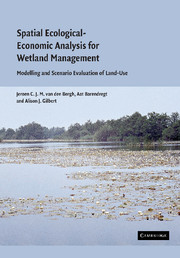
 Spatial Ecological-Economic Analysis for Wetland Management
 Modelling and Scenario Evaluation of Land Use
Book contents
- Frontmatter
- Contents
- List of figures
- List of tables
- Preface
- 1 Introduction
- 2 Wetlands and science
- 3 Integrated modelling and assessment
- 4 Theoretical framework and method of integrated study
- 5 The Vecht area: history, problems and policy
- 6 Development scenarios for the Vecht area
- 7 The spatial–ecological model: hydrology and ecology
- 8 The spatial–economic model: agriculture, nature conservation and outdoor recreation
- 9 Performance indicators for the evaluation
- 10 Evaluation of the scenarios
- 11 Conclusions: policy and research implications
- References
- Index
2 - Wetlands and science
Published online by Cambridge University Press: 24 November 2009

Book contents
- Frontmatter
- Contents
- List of figures
- List of tables
- Preface
- 1 Introduction
- 2 Wetlands and science
- 3 Integrated modelling and assessment
- 4 Theoretical framework and method of integrated study
- 5 The Vecht area: history, problems and policy
- 6 Development scenarios for the Vecht area
- 7 The spatial–ecological model: hydrology and ecology
- 8 The spatial–economic model: agriculture, nature conservation and outdoor recreation
- 9 Performance indicators for the evaluation
- 10 Evaluation of the scenarios
- 11 Conclusions: policy and research implications
- References
- Index
Summary
Introduction
This chapter provides a concise introduction to the elements – concepts, theories, methods and models for empirical analysis – contributed by the natural and social sciences to studies of wetlands. The case study discussed in Chapters 5 to 10 of the book will draw upon some of these elements. Section 2.2 presents the natural science perspective, focusing on hydrology and ecology, while Section 2.3 presents the social science perspective, focusing on environmental and ecological economics. Section 2.4 examines approaches to, and problems associated with, integrating the two perspectives.
Hydrology and ecology
According to the Ramsar definition, a wetland is an area where wet conditions predominate (see Section 1.2). Abiotic – chemical and hydrological – conditions of waters and soil together influence biological processes in a wetland, which in turn affect its environmental and economic functions. This section will provide information about these various connections, illustrated by examples taken from the Netherlands.
Processes and characteristics of hydrological systems
Each wetland is part of the hydrological cycle. The latter refers to the process of water evaporating from the surface of the earth and returning through precipitation: rain, snow, etc. The volume of precipitation is the major force in the cycle. Since gravity drives water flows, surface water ends up in rivers and oceans, where it can evaporate again (Chow, 1964; Manning, 1997; Ward and Robinson, 2000).
Information
- Type
- Chapter
- Information
- Spatial Ecological-Economic Analysis for Wetland ManagementModelling and Scenario Evaluation of Land Use, pp. 15 - 54Publisher: Cambridge University PressPrint publication year: 2004
Accessibility standard: Unknown
Why this information is here
This section outlines the accessibility features of this content - including support for screen readers, full keyboard navigation and high-contrast display options. This may not be relevant for you.Accessibility Information
Accessibility compliance for the PDF of this chapter is currently unknown
and may be updated in the future.