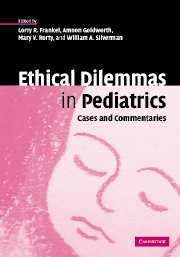
Book contents
- Frontmatter
- Contents
- List of contributors
- Preface
- Introduction
- Part I Therapeutic misalliances
- Part II Medical futility
- Part III Life by any means
- Part IV Institutional impediments to ethical action
- 10.1 Ethical problems encountered with oncology and bone marrow transplant patients
- 10.2 Ethics in the pediatric intensive care unit: oncology and bone marrow transplant patients
- 10.3 Topical discussion
- 11.1 Nursing perspectives on withholding food and fluids in pediatrics
- 11.2 Ethics and clinical decision making: withholding food and information
- 11.3 Topical discussion
- 12.1 Ethics and managed care
- 12.2 Challenging fidelity: the physician's role in rationing
- 12.3 Topical discussion
- References
- Index
11.2 - Ethics and clinical decision making: withholding food and information
Published online by Cambridge University Press: 18 August 2009

Book contents
- Frontmatter
- Contents
- List of contributors
- Preface
- Introduction
- Part I Therapeutic misalliances
- Part II Medical futility
- Part III Life by any means
- Part IV Institutional impediments to ethical action
- 10.1 Ethical problems encountered with oncology and bone marrow transplant patients
- 10.2 Ethics in the pediatric intensive care unit: oncology and bone marrow transplant patients
- 10.3 Topical discussion
- 11.1 Nursing perspectives on withholding food and fluids in pediatrics
- 11.2 Ethics and clinical decision making: withholding food and information
- 11.3 Topical discussion
- 12.1 Ethics and managed care
- 12.2 Challenging fidelity: the physician's role in rationing
- 12.3 Topical discussion
- References
- Index
Summary
Introduction
The moving story of Latasha's death and the care she received in the course of her dying brings home the poignancy of death in the pediatric unit. The conflation of the beginning of life and its end runs deeply contrary to our normal expectations and fondest hopes for children, and, as in this case, involves in its course people who are deeply committed to giving every possible support to vulnerable patients and their families.
I will comment on three aspects of the case Dr. Penticuff presents: the withdrawal of nutrition and hydration in infants; the relation of nursing ethics and clinical ethics; and the operation of the hospital ethics committee.
Withholding and withdrawing nutrition and hydration in infants
There are many reasons why it is difficult to deprive young children of the nutrition and hydration needed to sustain their lives. One often mentioned reason is the symbolic importance of nourishment; another is the extent to which not nourishing children goes in the face of our strongest instincts and inclinations. The relative unpredictability of the course of illness in the young makes it harder to take a decisive position which might seem to determine what that course will be.
It is interesting that, as Dr. Penticuff emphasizes, in Latasha's case the decision made was not directly one to withdraw nutrition and hydration, but specifically to limit the number of venopunctures for restarting hyperalimentation after infiltration of a site.
Information
- Type
- Chapter
- Information
- Ethical Dilemmas in PediatricsCases and Commentaries, pp. 246 - 252Publisher: Cambridge University PressPrint publication year: 2005
Accessibility standard: Unknown
Why this information is here
This section outlines the accessibility features of this content - including support for screen readers, full keyboard navigation and high-contrast display options. This may not be relevant for you.Accessibility Information
Accessibility compliance for the PDF of this chapter is currently unknown
and may be updated in the future.