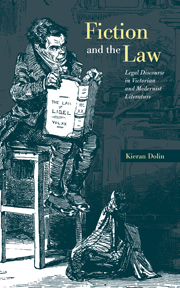
Book contents
- Frontmatter
- Contents
- Acknowledgments
- 1 Narrative forms and normative worlds
- 2 The modern Western nomos
- 3 True testimony and the foundation of nomos – The Heart of Midlothian
- 4 Reformist critique in the mid-Victorian “legal novel” – Bleak House
- 5 Representation, inheritance and anti-reformism in the “legal novel” – Orley Farm
- 6 Power, chance and the rule of law – Billy Budd, Sailor
- 7 From sympathetic criminal to imperial law-giver – Lord Jim
- 8 Freedom, uncertainty and diversity – the critique of imperialist law in A Passage to India
- 9 Settling out of court
- Notes
- Index
5 - Representation, inheritance and anti-reformism in the “legal novel” – Orley Farm
Published online by Cambridge University Press: 18 December 2009

Book contents
- Frontmatter
- Contents
- Acknowledgments
- 1 Narrative forms and normative worlds
- 2 The modern Western nomos
- 3 True testimony and the foundation of nomos – The Heart of Midlothian
- 4 Reformist critique in the mid-Victorian “legal novel” – Bleak House
- 5 Representation, inheritance and anti-reformism in the “legal novel” – Orley Farm
- 6 Power, chance and the rule of law – Billy Budd, Sailor
- 7 From sympathetic criminal to imperial law-giver – Lord Jim
- 8 Freedom, uncertainty and diversity – the critique of imperialist law in A Passage to India
- 9 Settling out of court
- Notes
- Index
Summary
Orley Farm (1861–2) occupies an important place in what the reviewer of Bleak House called “the Law Reports of Fiction.” Trollope's novel opens by stating that its ideal title would be “The Great Orley Farm Case” and warning readers that the less cumbersome actual title behoves no pastoral plot, but refers, like Bleak House, to a piece of real estate which has become the subject of an inheritance dispute. Just as the title of the novel may mislead, so the title to the property may not be what it seems. The self-conscious deliberations of the narrator play fully indicate the fictionality of the story, but in a move typical of Trollope, they lead smoothly into a narrative discourse which asserts its own historicity: “certain legal questions which made a considerable stir in our courts of law.”In this formulation the prescriptive “legal novel” inspired by Tales by a Barrister meets the sensationalism of the Causes Célèbres: rebellion and passion are domesticated, reduced to the genteel crime of forgery by a wife of her husband's will, with redress sought through law and conscience. Reviewing Orley Farm in The Times, E. S. Dallas whimsically reflected on the paideic possibilities of such fiction:
The legal student need no longer study his cases in thick volumes bound in yellow leather … he may study them in the loves of some Edwin and Angelina. If he looks for legal commentaries, he will find in the same pleasant pages abundance of useful reflections, illustrating perhaps not what the law is, but something much better – what it ought to be.
Information
- Type
- Chapter
- Information
- Fiction and the LawLegal Discourse in Victorian and Modernist Literature, pp. 97 - 120Publisher: Cambridge University PressPrint publication year: 1999
Accessibility standard: Unknown
Why this information is here
This section outlines the accessibility features of this content - including support for screen readers, full keyboard navigation and high-contrast display options. This may not be relevant for you.Accessibility Information
Accessibility compliance for the PDF of this chapter is currently unknown
and may be updated in the future.