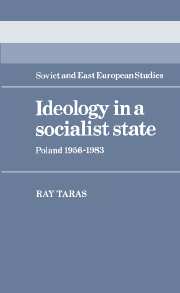
Book contents
- Frontmatter
- Contents
- Preface
- 1 The concept of ideology and Western sociology
- 2 Approaches to the study of ideology in a socialist state
- 3 The Polish road: fact and fable, 1956–59
- 4 Little stabilisation and great upheaval, 1960–70
- 5 Prosperity and political style in the second Poland, 1971–75
- 6 Propaganda of success and prognoses of failure, 1976–80
- 7 Interlude I: Solidarity, 1980–81
- 8 Interlude II: martial law, 1981–82
- 9 Operative ideology, fundamental principles and social reality
- Appendix: Central Committee Plenum meetings, Party Congresses and National Party Conferences, 1956–83
- Notes
- Bibliography
- Index
6 - Propaganda of success and prognoses of failure, 1976–80
Published online by Cambridge University Press: 21 September 2009
Book contents
- Frontmatter
- Contents
- Preface
- 1 The concept of ideology and Western sociology
- 2 Approaches to the study of ideology in a socialist state
- 3 The Polish road: fact and fable, 1956–59
- 4 Little stabilisation and great upheaval, 1960–70
- 5 Prosperity and political style in the second Poland, 1971–75
- 6 Propaganda of success and prognoses of failure, 1976–80
- 7 Interlude I: Solidarity, 1980–81
- 8 Interlude II: martial law, 1981–82
- 9 Operative ideology, fundamental principles and social reality
- Appendix: Central Committee Plenum meetings, Party Congresses and National Party Conferences, 1956–83
- Notes
- Bibliography
- Index

HTML view is not available for this content. However, as you have access to this content, a full PDF is available via the 'Save PDF' action button.
Summary
A category of people still exists whose main concern is simply to take, giving of themselves as little as possible. We continue to observe manifestations of ideological confusion and defeatist gossip. Also harmful are symptoms of conservatism, ordinary incompetence and organisational chaos which undermine the discipline required in a country embarking upon the road to modern development. We have not fully uprooted the proclivity towards smugness, the resting on one's laurels, the depreciation of one's obligations, and particularist viewpoints. We have not eliminated inclinations towards showiness, towards ‘success for appearance's sake’. We still encounter unpardonable examples of disregard for the ever more important value of time. We have limited the influence of mediocrity and trivialisation. But we cannot claim that we have fully exploited all the opportunities available for publicising the best results, for propagating and adopting the breakthroughs recorded by the truly leading forces in society, for continuously levelling upwards towards the best.
Nowe Drogi, October 1975If the primary programmatic concern of the Gierek leadership during the first half of the 1970s was to improve the general living standards of the population, then during the second half of the decade it was with ‘deepening the moral and political unity of the nation’ (as the Politburo report to the II National Party Conference was entitled), with the socialist integration of society, with the proper development of the ‘subjective factor’ which helped determine the quality of the society in which people lived.
Information
- Type
- Chapter
- Information
- Ideology in a Socialist StatePoland 1956–1983, pp. 143 - 175Publisher: Cambridge University PressPrint publication year: 1984
Accessibility standard: Unknown
Why this information is here
This section outlines the accessibility features of this content - including support for screen readers, full keyboard navigation and high-contrast display options. This may not be relevant for you.Accessibility Information
Accessibility compliance for the PDF of this chapter is currently unknown
and may be updated in the future.
 You have
Access
You have
Access